Learning
New lines by August Vale on learning, and 325 real quotes from 85 thinkers, each traced to the book, letter or speech it came from.































Learning
325 real quotes from 85 thinkers. Every one is traced to the book, letter or speech it came from.
Reimagined by August Vale
516 new lines Vale wrote after real quotes about learning. Tap one to see who.
Choose your five people like you are choosing your future, because you are.
Say yes to almost everything at twenty-five and to almost nothing at forty-five.
Wanting to be the best is ambition. Needing the others to be worse is envy.
The riskiest career move is ten safe years that taught you nothing new.
One mosquito can run your whole evening if you keep swatting at it.
The most trustworthy words a doctor can say are: I don’t know yet.
Ask your doctor the extra question. Nobody ever got sicker from understanding.
Judge a meal by how you feel an hour later. That’s the only review that counts.
Pain is the alarm, not the fire. Silencing it puts nothing out.
Look at one thing for a full minute. Most of us haven’t done that since we were six.
Every business starts as a favor somebody was glad to pay for.
Money is the only kind of wealth that fits in a wallet. That should tell you something.
Your best investment this year will look like a bad expense to everyone else.
A world that only pays for what sells will eventually have nothing new to sell.
Money never comes with instructions. You learn its use by watching who wastes it.
Before you sigh at a beginner, count how many years you were one.
Starting over makes you a beginner who already knows which stairs creak.
Good surgeons keep a list of their complications. Bad ones keep a list of excuses.
Some of your favorite streets are on detours you never chose.
Get cut from the team once and you learn what summers are for.
After a loss, sell your pride first. It fetches nothing and costs a fortune to store.
An error message is the most honest colleague you have. Read it before you swear at it.
Rock bottom has great acoustics. It’s the first place you hear yourself clearly.
Catch your own mistake and it’s a lesson. Let the boss catch it and it’s a meeting.
After a failure, everyone has advice. Listen to the ones with a failure of their own.
Chew a disappointment and it becomes judgment. Swallow it whole and it becomes bitterness.
Every failure has a cost column and a purchase column. Most people only read the first.
When you mess up, fix it first and feel bad second. The order matters.
Every we-tried-that-once is an old failure still sitting in on the meeting.
A failed project hands back two things: the lesson and the people who stayed. Keep both.
Strike out if you must, but notice which pitch fooled you. That’s next week’s practice.
Bomb one audition and you’ll learn what the room was really asking for.
A failed test is the most precise study guide you’ll ever be handed.
Fear is a bad student. It decides the answer before reading the question.
Some of the bravest acts on earth are a hand going up in a quiet room.
Wisdom is mostly a long list of things you used to be sure of.
When the game changes, the experts become beginners with longer résumés.
Get knocked over by one wave and the lesson is about that wave, not the ocean.
Beginners fear the blank page. Masters fear the page that filled itself too easily.
Explain it to a beginner and every gap in what you know will raise its hand.
The student who argues with you has started thinking. The one who only nods has started copying.
Getting better mostly feels like noticing more of your own mistakes.
Practicing what you already do well isn’t practice. It’s a concert for one.
The world doesn’t hire the best. It hires the best it has heard of.
Anyone can teach the eager. Mastery is making the bored lean in.
Study your heroes closely enough to find their mistakes. That’s where your own work begins.
Grade a teacher by the questions her students are still asking ten years later.
An expert’s eye isn’t sharper. It just knows where to look first.
A coach sees what you do. A mentor sees who you’re turning into.
Pick the teacher who makes you feel slow, not the one who makes you feel clever.
An answer you were handed is a souvenir. One you dug up is a tool.
Copy down every word of the lecture and you leave with a transcript, not a skill.
Inventors don’t have more ideas. They test more of the silly ones.
A good editor makes you sound more like yourself, not more like them.
Every chef’s signature dish started as a rescue of something that went wrong.
Apprentices who only sweep, sweep forever. Watch the hands while you hold the broom.
You only fully see a masterpiece after you’ve failed to make one.
Everyone loves giving advice about the part that came easily to them.
Ask a mentor about their worst year. That’s where they keep the useful part.
Some of your best teachers will be younger than your car. Listen anyway.
You can’t teach anyone to be original. You can only stop teaching them to be the same.
Most great laboratories were sheds with a stubborn person inside.
Mastery is when your hands finish the thought before your head does.
Find a mentor ten years ahead, not fifty. You can still see their footprints.
Anyone can play the pretty bars. Practice the awkward change between them.
Beginners need the rules. Masters need the reasons behind them.
Half of any craft is throwing away good work to make room for better.
Every expert you admire was once the most annoying person in class, asking why.
Two average skills nobody else combines beat one great skill everybody has.
The inner critic guards the door. Walk past him with a deliberately bad first sentence.
Taste is knowing why you love it. Skill is making more of it on purpose.
Good mentors answer your question with a better one, then wait.
Teach what you learned last year. You still remember why it was hard.
The hardest lesson for a gifted student is how to be bad at something.
Choose a teacher by watching their students, not their trophies.
Thank the teacher who was hard on you. They were betting on someone you hadn’t met yet.
Nothing teaches a craft like fixing someone else’s bad version of it.
Ideas pass everyone. Only the people carrying a notebook keep any.
A teacher’s résumé is scattered across other people’s careers.
A workshop starts dying the day the old hands stop talking to the new ones.
Get good without getting grim. The fun is what got you here.
Show work early to people who’ll improve it, and late to people who’ll judge it.
A good apprentice learns the master’s habits. A great one learns the master’s doubts.
Watch what an old craftsman refuses to do. That’s the part no manual covers.
Everyone wants a mentor. Few are the kind of student worth an afternoon.
Beginners count the hours. Masters count the mistakes they’ve stopped making.
Practice builds the skill. Performance shows you where it’s still thin.
Creativity needs a little arrogance to start and a lot of humility to finish.
Every master was taught by somebody who never became famous.
Feedback is a free mirror. Most people only look on good hair days.
Don’t ask if you’re talented. Ask if you’re still interested.
Follow the crowd and you’ll end up where crowds always end up: the gift shop.
Anyone happy with a good book and a long walk has already beaten the economy.
Not every class, course and podcast is growth. Some of it is just restlessness with homework.
Fix it yourself once and you’ll own it in a way no receipt can manage.
You can hire a tutor for the facts. Judgment is taught at the dinner table.
Fight in front of the kids if you must. Then make up in front of them too.
Compare your children to each other and you’ll raise rivals who share a last name.
Your kids are watching how you treat your parents. Consider it a preview of your seventies.
Teach your kids to disagree with you politely. You’ll be negotiating with them for sixty years.
Build on someone’s idea before you point out the cracks. Then they’ll actually hear you.
Arguing with someone is a compliment. Nobody bothers to disagree with a person they’ve written off.
Empathy is a passport. Most people only stamp it for countries they already like.
You don’t have to have been there. You just have to stay there while they tell it.
A real friend can tell you’re not fine from the punctuation.
Whoever taught you to read handed you every teacher you’ve had since.
Ask what someone thinks before you say what you think. Afterward you’ll only hear an echo.
A generous listener makes everyone at the table a better storyteller.
Most people don’t need your opinion. They need company while they find their own.
Write to an old teacher. They almost never find out how the story ended.
Praise from an honest friend is worth ten from a polite one.
You can’t stop the birthdays. You can change what each one finds.
Take a walk with no destination. The best ideas don’t book appointments.
There’s no perfect diet, only the one you can still stand by Wednesday.
End the day with a book, not a feed. Your sleep can tell the difference.
Don’t save the soup and the early night for when you’re sick.
New strength is the dangerous kind. Handle it like a new knife.
When your head won’t stop spinning, give it something new to hold.
Deep focus is built in long sittings. It won’t grow in five-minute gaps.
Work you love still tires your legs. It just never tires your reasons.
Make something with your hands every week. Your head will thank them.
Hang a new habit on an old one. The familiar carries the stranger in.
A great training plan is worth exactly as many sessions as you show up for.
Use guilt like a compass, not a whip. Check the direction, then put it away.
The best reason to get strong is to be useful when someone you love needs carrying.
After an illness, start again as a beginner. The fever leaves before the strength comes back.
Adults learn to swim slowest because they hate looking like beginners.
Change the route now and then. Legs get bored before minds admit it.
Most people stop training the week they reach the goal. That’s the week the real job starts.
A coach can teach the form. The six a.m. alarm is still addressed to you.
The habit you build for a small reason gets drafted for a big one later.
A sweet tooth is trained like any muscle. Stop lifting with it and it shrinks.
The first ten minutes of a run are a liar. Every runner learns to wait them out.
Learn to cook. It’s the one class that pays you back three times a day.
Everyone knows what to eat. The hard part was never the knowing.
Old age is a long conversation with yourself. Have something to say by then.
Forgotten isn’t wasted. Most good days end up in the foundation, not the photo album.
Age is the one climb where the view improves as the legs give out.
Old age doesn’t hand out dignity. You have to bring your own.
Twenties spent curious are never wasted, even on the wrong things.
The old aren’t wise so much as tired of being wrong in the same old ways.
We moved dying into hospitals and lost the words for it at home.
Nobody likes being dragged to a conclusion. Everybody likes arriving at one.
Say it clearly. Making people guess what you meant is a small cruelty.
When smart people disagree, the answer is usually standing between them.
Don’t pad every corner of a child’s life. Bruises teach the shape of the room.
Kids can’t aim at a life they’ve never seen. Let them see yours.
A visit where nobody says what they really think is just furniture sharing a room.
Give one friend permission to edit you. Then don’t argue with the red ink.
Bond over a shared enemy and the friendship ends the week the enemy leaves.
Good friends don’t need the same road. They just keep the same pace.
Stay curious about old friends. Most of them changed while you weren’t asking.
The sweetest work there is: handing someone a tool they never have to give back.
It’s hard to hate someone once you’ve heard how their week went.
Children don’t respect the title. They respect the person wearing it on a hard day.
Attention is the one gift nobody can fake for more than a minute.
The talker leaves with what he brought. The listener leaves with two people’s worth.
Asking for advice is a compliment. Taking it is a bigger one.
The moment someone depends on you, your ignorance stops being private.
Outgrowing a friend isn’t betrayal. Pretending you haven’t is.
Friends from other worlds are how you find out which of your rules are only habits.
Couples don’t have a hundred fights. They have one, in a hundred outfits.
Most people run their love life on a copy of their parents’ manual, lightly edited.
Improve yourself the way you’d stock a pantry: for whoever comes knocking.
Notice your people on ordinary days, so you’ll know when it isn’t one.
Every few years, ask how you’d build this marriage if you were starting it today.
Most of the people who changed your life arrived as problems.
Care isn’t only for the sick. The healthy people you love need tending too.
Every hard conversation you get through leaves you a tool for the next one.
Accepting help is a kindness too. It lets someone else be useful.
Forgive yourself the way you’d forgive a friend: quickly, and without a speech.
A good talk ends with both of you holding a thought neither one brought.
The most useful map you’ll ever draw is the outline of what you don’t know.
A good teacher builds you a door, then gets out of the doorway.
Reading gets you introduced to an idea. Writing finds out if you were listening.
A memory full of facts is a stocked pantry. Judgment is the one who can cook.
Some truths are too big for a fact sheet. They only fit inside a story.
An idea isn’t knowledge until you’ve given it a fair chance to fail.
A full bookshelf proves you shop. Only the margins prove you read.
Facts don’t stick on their own. Tie each one to three things you already know.
Every subject worth knowing has a boring chapter guarding the good ones.
College hands you other people’s thoughts. Thinking is the class you take alone.
Dull steel takes an edge too. It just needs more passes on the stone.
Own your ideas the way you own a hammer. The moment you salute one, it owns you.
Studying ethics makes you good the way reading menus makes you full.
Most of us don’t need more books. We need to finish digesting the last one.
Some of your closest friends died centuries ago and still answer every night.
Before you mock someone for not knowing, check whether anyone ever showed them.
Claiming an open mind costs nothing. The receipt is the last time you changed it.
Some of the wisest people you’ll meet learned it with their hands.
Fear can make a child memorize. Only delight makes them keep it.
Learning something new is the one pleasure with no hangover.
Everyone practices their golf swing. Almost nobody practices saying what they mean.
Few of us think of the good idea first. All of us can recognize it when it walks in.
Most people age twice: once in the face and, much earlier, in their opinions.
Life rarely pays out in joy. It pays in understanding, which keeps longer.
Announce you’re certain and the people who know better go quiet.
You know more than you’d admit in an interview and less than you’d claim at a party.
Knowledge doesn’t sit still. It’s either growing or leaking.
Name one thing you’ve ever done better while half paying attention.
Learn one hard thing and you’ll catch yourself shopping for another.
The grit that finishes the textbook is the grit that finishes the last lap.
Everyone mourns their old dreams. Nobody notices the questions they stopped asking.
The brain you were given is a starter kit, not the final model.
You will be bad at it first. That’s the entrance fee, not the verdict.
Treat your beliefs like experiments, not clients you have to defend.
Starting over costs you your title and gives you back your questions.
Wisdom is a slow drip. Most people never leave the tap on long enough.
Most people stop learning at graduation. That’s why they’re so easy to pass.
A line moves just fast enough that nobody asks where it leads.
Persistence doesn’t just get you there. It changes who arrives.
Taste is mostly a pile of mistakes you finally learned from.
Teach a mind its first letter and no lock in the world fits it again.
Nobody gets argued out of a belief. They talk themselves out of it later, in private.
Reciting wisdom is a party trick. Using it on a bad day is the degree.
One book at the right moment can split a life into before and after.
There’s the ignorance of beginners and the ignorance of experts. Only the first kind asks questions.
Outgrowing a teacher is the best grade they’ll ever give you.
You only hear the parts of advice you were already ready for.
Waking up from a wrong idea feels like the best morning of the year.
Humanity keeps the notes. Every person still has to take the class.
Study what bores you and your memory quietly returns it unopened.
Admit what you don’t know and people start believing what you do.
Ask why it’s done this way until someone says because. That’s where the opening is.
Want the truth more than you want to look right. Looking right expires.
Learn one thing the slow way. Every lesson after it comes at a discount.
Their hate is theirs to carry. Don’t offer to take a corner.
A lot of what feels like sadness is just a life that stopped growing.
Ask one more question than feels polite. That’s usually where the good part is.
Opinions have a shelf life. Check the date before you serve one.
Stay a beginner at something. Minds set like concrete when nobody stirs them.
Stop staring at the lock. The key usually turns up in another pocket.
Resilience isn’t issued at birth. It’s a callus, and calluses come from use.
The person who could quit tomorrow usually does the best work today.
A calling never checks the salary. Somebody in the house had better.
Money never tells you what to want. It just stops saying no.
Sell one thing you made and you’ll understand money better than any book explains it.
Everyone has a blind spot. Choose friends who sit on that side.
Blushing is good news. It means your conscience still has the keys.
Wear your principles like shoes, not medals. They’re for walking.
Chase prestige and you’ll keep arriving at last decade’s party.
Serial builders are mostly serial failures who kept their tools.
Master one thing and you’ve earned a diploma nobody can print.
Nobody hands out permission slips for the interesting stuff.
Volunteer for the hardest problem in the building. It’s the fastest promotion there is.
Most competitive edges are just paying attention a little longer than the next person.
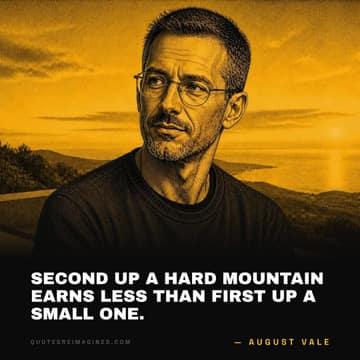
Second up a hard mountain earns less than first up a small one.
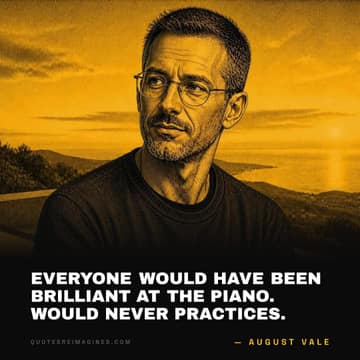
Everyone would have been brilliant at the piano. Would never practices.
The second-smartest person in any room is the one who’ll take a note.
A great idea explained badly loses to a decent one explained well.
Study only yourself and you’ll lose to someone who studied you too.
A mentor shortens the road. A flatterer only makes it feel shorter.
Everyone admires the trophy. Few will turn into the person who lifts it.
Chase the prize. Miss it, and you still come home with an education.
Plot the route from where your feet are, not from where the dream is.
Quoting the expert is memory. Checking the expert is thinking.
Most pitches fail because the person pitching never stops to listen.
Every new skill is built from an old one you forgot you had.
Not knowing is forgivable. Refusing to find out is the real failure.
Most new ideas are an old habit carried into the wrong room.
Every new rule is a small confession that someone stopped trusting judgment.
The second try has an unfair advantage. It has met the first one.
Nobody signs up for a life’s work. They sign up for a small question that won’t let go.
Guard against every fall and you’ll spend your life on the ground floor.
Becoming who you want is hard. Staying who you don’t want to be is harder, just slower.
Skill in the wrong hands just gets the wrong job done faster.
You’ll make your last mistake the day you stop trying things.
Books teach you the trade. People teach you how to get paid for it.
You can hire knowledge by the hour. Judgment you have to grow at home.
A burn should teach you where the handle is, not cancel dinner.
Nobody frames the ninety sketches. You still have to draw them.
The smallest goal you’re desperate about beats the grandest one you’re polite about.
Leadership is saying the same thing until you’re sick of it, then saying it to the new hire.
Every crash leaves a black box. Read it before you fly again.
A failed try proves the try failed. It says nothing yet about the idea.
Every ambition is an apprenticeship to someone you haven’t become yet.
Reading biographies is the comfiest way to skip writing one.
Build the ugly version. It settles arguments a meeting never could.
Nobody finds their life’s work by thinking. You trip over it while working.
The fastest shortcut in any field is the question you’re too proud to ask.
Your greatest strength is the cliff you’ll walk off whistling.
Teach a child to sit with boredom and you’ve given them company for life.
Take your childhood obsessions seriously. They’re the first draft of your life.
Quitting a dull book isn’t failure. It’s a refund on your hours.
Learn it before it’s needed. Once it’s obvious, everyone’s in line.
Old books are the only way to live in more than one century.
Children who learn about endings early tend to love the middle more.
Of all the centuries on offer, you got this one. Don’t spend it complaining about the seat.
Every finish line is painted on the back of a starting line.
Some books can only be read at forty, no matter how early you start them.
Before you say it’s too late, finish the sentence. Too late for what?
Nobody who truly wanted to learn ever waited for a free afternoon.
Nobody has been this age before. Give yourself a beginner’s patience.
Learning shows up as patience long before it shows up as answers.
One hand on the railing behind you, one reaching up. Stairs take both.
Some lessons only come with the years. Nobody can speed-read a decade.
A habit started at sixty still has a long career ahead of it.
A long life asks one skill above all: starting over without sulking.
If they still don’t get it on the third try, check the teacher.
Skimming a great book is like gulping a great wine. You paid for the taste.
Everyone is slow at something you’re fast at. Remember that when the line stops moving.
Interrupting tells someone your thought can’t wait and theirs can.
Let the young be wrong for a while. Nobody ever learned a road from the passenger seat.
Spend the waiting getting ready. The door won’t hold itself open.
Thank whoever told you. Everyone else just let you walk around like that.
A room that always agrees with you is a mirror with a salary.
The scariest silence is a friend who stopped correcting you.
Your team will forget every speech. They’ll remember how you treated the first person who messed up.
If everyone loves your work, check whether you only showed it to people who love you.
Correct someone’s grammar mid-argument and you’ve told everyone you ran out of points.
Listen to a complaint all the way to the end. The real one is usually the last sentence.
A genius who can’t get paid ends up working for someone who can.
Buy books faster than you can read them. It’s the one shelf where overspending pays.
Mind your own field and you won’t have hours left to count your neighbor’s harvest.
By the time a tip reaches you, the price has already heard it.
Early on, take your pay in lessons. They compound faster than salary.
Pay for a mistake once and it’s a lesson. Pay twice and it’s a subscription.
Pick a road that runs downhill. Even average legs look fast on it.
The best education costs a lunch with someone who knows more.
The best emergency fund is a skill you can sell on short notice.
Spend on what you touch every day. Save on what you show once a year.
The calmest investors read old books. Every panic is a rerun.
Three words, I don’t know, have saved more fortunes than any spreadsheet.
Everything you buy gets dull eventually. A good book gets better the second time.
Ask what you’d do with a free year. That’s what the money is for.
Live on a street of millionaires and you’ll feel poor by Friday.
Know your own temper before you study the market. Most losses start at home.
Poverty’s biggest cost never shows up on a bill. It shows up as talent that never got a turn.
Money habits outlive the reasons you formed them. Check yours every few years.
Advice can prepare you for money. Only a few bad purchases make you ready.
Lend your favorite book as if it’s a gift. It usually becomes one.
Half of what people believe about money, they heard once and never checked.
If you don’t understand it, you don’t own it. You’re holding it for someone who does.
The original quotes
For it is impossible for a man to begin to learn that which he thinks that he knows.
To know and yet (think) we do not know is the highest (attainment); not to know (and yet think) we do know is a disease.
We all love to instruct, though we can teach only what is not worth knowing.
If you know yourself but not the enemy, for every victory gained you will also suffer a defeat.
It is indeed an honourable sentiment which Solon expresses in a verse which I have quoted before—that he grew old learning many a fresh lesson every day.
Who follows another, follows nothing, finds nothing, nay, is inquisitive after nothing.
Reading maketh a full man; conference a ready man; and writing an exact man.
It is more necessary to study men than books.
How can a man come to know himself? Never by thinking, but by doing.
It is not enough to know, we must also apply; it is not enough to will, we must also do.
Integrity without knowledge is weak and useless, and knowledge without integrity is dangerous and dreadful.
We learn wisdom from failure much more than from success. We often discover what will do, by finding out what will not do; and probably he who never made a mistake never made a discovery.
The body ceases to grow in a few years; but the mind, if we will let it, may grow as long as life lasts.
We should be careful to get out of an experience only the wisdom that is in it—and stop there; lest we be like the cat that sits down on a hot stove-lid.
The best-educated people are those who are always learning, always absorbing knowledge from every possible source and at every opportunity.
The moment a young man or woman gets more money than he or she has grown to by practical experience, that moment he has gotten a curse.
Your pain is the breaking of the shell that encloses your understanding.
We slowly learn that life consists of processes as well as results, and that failure may come quite as easily from ignoring the adequacy of one's method as from selfish or ignoble aims.
As always, we learn as much from our failures as our successes, and are constantly reminded that execution and delivery matter as much as great ideas.
Your mentors may leave you prepared, but they can’t leave you ready.
Education is one of the blessings of life—and one of its necessities.
I constantly see people rise in life who are not the smartest, sometimes not even the most diligent. But they are learning machines. They go to bed every night a little wiser than they were that morning.
I fundamentally believe that if you are not learning new things, you stop doing great and useful things.
Collectively, we are moving from a group of people who know it all to a group of people who want to learn it all.
There's a kind of excited curiosity that's both the engine and the rudder of great work.
Ambition tends to make you climb existing peaks, but if you stick close enough to an interesting enough question, it may grow into a mountain beneath you.
The only way it gets better for you is when you get better. Better is not something you wish for; better is something you become.
I try, try, try and fail. Only then will I learn and improve the way to do things.
There is nothing wrong with making a mistake. But making the same mistake over and over because you have not analyzed it to find out what happened is unforgivable.
To achieve something you’ve never achieved before, you must become someone you’ve never been before.
Never try to be better than someone else, always learn from others. Never cease trying to be the best you can be—that's under your control.
If any man is able to convince me and show me that I do not think or act right, I will gladly change; for I seek the truth, by which no man was ever injured. But he is injured who abides in his error and ignorance.
Remember that to change thy opinion and to follow him who corrects thy error is as consistent with freedom as it is to persist in thy error.
Do the things external which fall upon thee distract thee? Give thyself time to learn something new and good, and cease to be whirled around.
Accustom thyself to attend carefully to what is said by another, and as much as it is possible, be in the speaker's mind.
Have I the consciousness, which a man who knows nothing ought to have, that I know nothing?
Every great power (faculty) is dangerous to beginners.
Learn my opinions: show me yours; and then say that you have visited me.
Do you also show the illiterate man the truth, and you will see that he follows. But so long as you do not show him the truth, do not ridicule him, but rather feel your own incapacity.
It is ridiculous then to think that a person wishes to learn one thing, and will learn another; or further, that a man will make proficiency in that which he does not learn.
Do you also show not your theorems to the uninstructed, but show the acts which come from their digestion.
It is not easy to exhort weak young men; for neither is it easy to hold (soft) cheese with a hook. But those who have a good natural disposition, even if you try to turn them aside, cling still more to reason.
Let us examine one another: if I have any bad opinion, take it away; if you have any, show it.
If then we shall not also put in practice right opinions, we shall be nothing more than the expositors of the opinions of others. For now who among us is not able to discourse according to the rules of art about good and evil things (in this fashion)?
A good man delights in receiving advice: all the worst men are the most impatient of guidance.
Since Nature allows us to commune with every age, why do we not abstract ourselves from our own petty fleeting span of time, and give ourselves up with our whole mind to what is vast, what is eternal, what we share with better men than ourselves?
Very few men are led by their own reason: those who come next to the best are those who return to the right path in consequence of advice; and these we must not deprive of their guide.
Let a man, then, obtain as many books as he wants, but none for show.
I shall never be ashamed to quote a good saying because it comes from a bad author.
The second best form of virtue is to be willing and able to take advice.
If you wish information and improvement from the knowledge of others, and yet at the same time express yourself as firmly fix'd in your present opinions, modest, sensible men, who do not love disputation, will probably leave you undisturbed in the possession of your error.
For, if you would inform, a positive and dogmatical manner in advancing your sentiments may provoke contradiction and prevent a candid attention.
From a child I was fond of reading, and all the little money that came into my hands was ever laid out in books.
The best books are not read even by those who are called good readers.
The works of the great poets have never yet been read by mankind, for only great poets can read them.
How many a man has dated a new era in his life from the reading of a book.
How could youths better learn to live than by at once trying the experiment of living?
Books are the treasured wealth of the world and the fit inheritance of generations and nations.
It is a vulgar error to suppose that you have tasted huckleberries who never plucked them.
I declare, after all, there is no enjoyment like reading! How much sooner one tires of anything than of a book!
If I had ever learnt, I should have been a great proficient.
To study hard implies character in the student, and to work hard at a sport which entails severe physical exertion and steady training also implies character.
Shiftlessness, slackness, indifference in studying, are almost certain to mean inability to get on in other walks of life.
The best boys I know —the best men I know—are good at their studies or their business, fearless and stalwart, hated and feared by all that is wicked and depraved, incapable of submitting to wrong-doing, and equally incapable of being aught but tender to the weak and helpless.
It is thought that to know about great men and great deeds is quite sufficient, and that other exertion is not necessary. And therefore this learning shall not eat, but shall perish of hunger while seeing all things transformed into gold by its touch.
Is it not pleasant to learn with a constant perseverance and application?
At fifteen, I had my mind bent on learning.
A superior man, in regard to what he does not know, shows a cautious reserve.
Hear much and put aside the points of which you stand in doubt, while you speak cautiously at the same time of the others:—then you will afford few occasions for blame.
If the scholar be not grave, he will not call forth any veneration, and his learning will not be solid.
A man is not learned because he talks much; he who is patient, free from hatred and fear, he is called learned.
If a fool be associated with a wise man even all his life, he will perceive the truth as little as a spoon perceives the taste of soup.
A man who has learnt little, grows old like an ox; his flesh grows, but his knowledge does not grow.
Through zeal knowledge is gotten, through lack of zeal knowledge is lost; let a man who knows this double path of gain and loss thus place himself that knowledge may grow.
If you see an intelligent man who tells you where true treasures are to be found, who shows what is to be avoided, and administers reproofs, follow that wise man; it will be better, not worse, for those who follow him.
Old men retain their intellects well enough, if only they keep their minds active and fully employed.
You may be sure, my dear Scipio and Laelius, that the arms best adapted to old age are culture and the active exercise of the virtues.
All teaching, and all intellectual learning, proceeds on the basis of previous knowledge, as will appear on an examination of all.
Of course, we must begin with what is known; but then this is of two kinds, what we do know, and what we may know: perhaps then as individuals we must begin with what we do know.
To learn that a man has said or done a foolish thing is nothing: a man must learn that he is nothing but a fool, a much more ample, and important instruction.
Most men are rich in borrowed sufficiency: a man may say a good thing, give a good answer, cite a good sentence, without at all seeing the force of either the one or the other.
In earnest, I rather choose the company of those who ruffle me than of those who fear me; ‘tis a dull and hurtful pleasure to have to do with people who admire us and approve of all we say.
In plain truth, the cares and expense our parents are at in our education, point at nothing, but to furnish our heads with knowledge; but not a word of judgment and virtue.
Whoever will be cured of ignorance must confess it.
Knowledge is an excellent drug, but no drug has virtue enough to preserve itself from corruption and decay, if the vessel be tainted and impure wherein it is put to keep.
I condemn all violence in the education of a tender soul that is designed for honour and liberty.
A man may say with some colour of truth that there is an Abecedarian ignorance that precedes knowledge, and a doctoral ignorance that comes after it: an ignorance that knowledge creates and begets, at the same time that it despatches and destroys the first.
To hunt after truth is properly our business, and we are inexcusable if we carry on the chase impertinently and ill; to fail of seizing it is another thing, for we are born to inquire after truth: it belongs to a greater power to possess it.
We only labour to stuff the memory, and leave the conscience and the understanding unfurnished and void.
All other knowledge is hurtful to him who has not the science of goodness.
To know by rote, is no knowledge, and signifies no more but only to retain what one has intrusted to our memory.
Crafty men contemn studies, simple men admire them, and wise men use them; for they teach not their own use; but that is a wisdom without them, and above them, won by observation.
Generally, youth is like the first cogitations, not so wise as the second. For there is a youth in thoughts, as well as in ages.
Histories make men wise; poets witty; the mathematics subtile; natural philosophy deep; moral grave; logic and rhetoric able to contend.
For it breeds great perfection, if the practice be harder than the use.
In the discharge of thy place, set before thee the best examples; for imitation is a globe of precepts.
We owe a great debt to those who point out faults.
Men are never taught to be gentlemen, and are taught everything else; and they never plume themselves so much on the rest of their knowledge as on knowing how to be gentlemen.
Let no one say that I have said nothing new; the arrangement of the subject is new.
Two things instruct man about his whole nature; instinct and experience.
If man made himself the first object of study, he would see how incapable he is of going further.
Do not draw this conclusion from your experiment, that there remains nothing for you to know; but rather that there remains an infinity for you to know.
A wise man ought always to follow the paths beaten by great men, and to imitate those who have been supreme, so that if his ability does not equal theirs, at least it will savour of it.
Because there are three classes of intellects: one which comprehends by itself; another which appreciates what others comprehended; and a third which neither comprehends by itself nor by the showing of others; the first is the most excellent, the second is good, the third is useless.
Our life is an apprenticeship to the truth that around every circle another can be drawn; that there is no end in nature, but every end is a beginning; that there is always another dawn risen on mid-noon, and under every deep a lower deep opens.
Every man’s progress is through a succession of teachers, each of whom seems at the time to have a superlative influence, but it at last gives place to a new.
Every moment instructs, and every object: for wisdom is infused into every form.
Each mind has its own method. A true man never acquires after college rules.
Happy is the hearing man; unhappy the speaking man.
People must learn to see; they must learn to think, and they must learn to speak and to write: the object of all three of these pursuits is a noble culture.
The charm of knowledge would be small, were it not so much shame has to be overcome on the way to it.
The more abstract the truth you wish to teach, the more must you allure the senses to it.
One no longer loves one's knowledge sufficiently after one has communicated it.
To learn to see—to accustom the eye to calmness, to patience, and to allow things to come up to it; to defer judgment, and to acquire the habit of approaching and grasping an individual case from all sides.
In order to acquire intellect, one must be in need of it.
Let your enemies' censure be like a bitter medicine, to be used as a means of self-knowledge.
Activity!—doing something, if possible creating something, at any rate learning something—how fortunate it is that men cannot exist without that!
Instead of finding, as we expected, pleasure, happiness, joy, we get experience, insight, knowledge—a real and permanent blessing, instead of a fleeting and illusory one.
It would be a great advantage to a young man if his early training could eradicate the idea that the world has a great deal to offer him.
Every man hears only what he understands.
A man who has no acquaintance with foreign languages knows nothing of his own.
With the growth of knowledge our ideas must from time to time be organised afresh.
Nothing is more terrible than ignorance in action.
What is original in us is best preserved and quickened if we do not lose sight of those who have gone before us.
What a master a man would be in his own subject if he taught nothing useless!
It is only when a man knows little, that he knows anything at all. With knowledge grows doubt.
What a man does not understand, he does not possess.
How many years must a man do nothing before he can at all know what is to be done and how to do it!
First let a man teach himself, and then he will be taught by others.
The century advances; but every individual begins anew.
Wealth is nothing but as it is bestowed, and knowledge nothing but as it is communicated.
Ignorance is mere privation, by which nothing can be produced; it is a vacuity in which the soul sits motionless and torpid for want of attraction, and, without knowing why, we always rejoice when we learn, and grieve when we forget.
Ignorance, when it is voluntary, is criminal; and he may properly be charged with evil who refused to learn how he might prevent it.
If we act only for ourselves, to neglect the study of history is not prudent. If we are entrusted with the care of others, it is not just.
The mind may accumulate large stores of knowledge without any useful purpose; but the knowledge must be allied to goodness and wisdom, and embodied in upright character, else it is naught.
An hour wasted daily on trifles or in indolence, would, if devoted to self-improvement, make an ignorant man wise in a few years, and employed in good works, would make his life fruitful, and death a harvest of worthy deeds.
The object of knowledge should be to mature wisdom and improve character, to render us better, happier, and more useful; more benevolent, more energetic, and more efficient in the pursuit of every high purpose in life.
For all experience serves to illustrate and enforce the lesson, that a man perfects himself by work more than by reading,—that it is life rather than literature, action rather than study, and character rather than biography, which tend perpetually to renovate mankind.
Knowledge conquered by labour becomes a possession—a property entirely our own.
The possession of a library, or the free use of it, no more constitutes learning, than the possession of wealth constitutes generosity.
For no matter how poor or humble a man may be, the great thinker of this and other days may come in and sit down with him, and be his companion for the time, though his dwelling be the meanest hut.
The extremest poverty has been no obstacle in the way of men devoted to the duty of self-culture.
We suffer much, no doubt, from the faults of others, but we lose much more by our own ignorance.
Education ought not to cease when we leave school; but if well begun there, will continue through life.
The important thing is not so much that every child should be taught, as that every child should be given the wish to learn.
Training is everything. The peach was once a bitter almond; cauliflower is nothing but cabbage with a college education.
We live in an age that reads too much to be wise, and that thinks too much to be beautiful.
The thoroughly well-informed man—that is the modern ideal. And the mind of the thoroughly well-informed man is a dreadful thing.
The aim of life is self-development. To realize one’s nature perfectly—that is what each of us is here for.
In the wild struggle for existence, we want to have something that endures, and so we fill our minds with rubbish and facts, in the silly hope of keeping our place.
You know more than you think you know, just as you know less than you want to know.
Though conscious of the difficulty of learning without a teacher, I set out with high hope, and a fixed purpose, at whatever cost of trouble, to learn how to read.
Mistress, in teaching me the alphabet, had given me the inch, and no precaution could prevent me from taking the ell.
The more I read, the more I was led to abhor and detest my enslavers.
I consoled myself with the hope that I should one day find a good chance. Meanwhile, I would learn to write.
The work of instructing my dear fellow-slaves was the sweetest engagement with which I was ever blessed.
I taught them, because it was the delight of my soul to be doing something that looked like bettering the condition of my race.
When I was sent of errands, I always took my book with me, and by going one part of my errand quickly, I found time to get a lesson before my return.
During this time, my copy-book was the board fence, brick wall, and pavement; my pen and ink was a lump of chalk.
The light broke in upon me by degrees.
Instead of studying books so constantly, how I wish that our schools and colleges might learn to study men and things!
The older I grow, the more I am convinced that there is no education which one can get from books and costly apparatus that is equal to that which can be gotten from contact with great men and women.
At Hampton I not only learned that it was not a disgrace to labour, but learned to love labour, not alone for its financial value, but for labour’s own sake and for the independence and self-reliance which the ability to do something which the world wants done brings.
I determined, when quite a small child, that, if I accomplished nothing else in life, I would in some way get enough education to enable me to read common books and newspapers.
Despite this disappointment, however, I determined that I would learn something, anyway.
Few were too young, and none too old, to make the attempt to learn.
I did find, though, that which no costly building and apparatus can supply,—hundreds of hungry, earnest souls who wanted to secure knowledge.
About twenty of us formed a society for the purpose of utilizing this time in debate or in practice in public speaking. Few persons ever derived more happiness or benefit from the use of twenty minutes of time than we did in this way.
I like to be sure that I am reading about a real man or a real thing.
Any teacher can take a child to the classroom, but not every teacher can make him learn.
With the first word I used intelligently, I learned to live, to think, to hope. Darkness cannot shut me in again.
I learned for the first time to know an author, to recognize his style as I recognize the clasp of a friend's hand.
One goes to college to learn, it seems, not to think.
Education broadens to include all men, and deepens to reach all truths.
Great poetry, whether written in Greek or in English, needs no other interpreter than a responsive heart.
When I read the finest passages of the Iliad, I am conscious of a soul-sense that lifts me above the narrow, cramping circumstances of my life.
To know the thoughts and deeds that have marked man's progress is to feel the great heart-throbs of humanity through the centuries; and if one does not feel in these pulsations a heavenward striving, one must indeed be deaf to the harmonies of life.
As my knowledge of things grew I felt more and more the delight of the world I was in.
Even when I studied most earnestly it seemed more like play than work.
Seated in the gracious shade of a wild tulip tree, I learned to think that everything has a lesson and a suggestion.
I built dams of pebbles, made islands and lakes, and dug river-beds, all for fun, and never dreamed that I was learning a lesson.
The child will always attend more to what a teacher does than to what the same teacher says.
Education is for behavior, and habits are the stuff of which behavior consists.
Let no youth have any anxiety about the upshot of his education, whatever the line of it may be.
In almost any subject your passion for the subject will save you.
Depend upon it, no one need be too much cast down by the discovery of his deficiency in any elementary faculty of the mind.
Briefly, then, of two men with the same outward experiences, the one who thinks over his experiences most, and weaves them into the most systematic relations with each other, will be the one with the best memory.
The 'secret of a good memory' is thus the secret of forming diverse and multiple associations with every fact we care to retain.
The most durable impressions are those on account of which we speak or act, or else are inwardly convulsed.
The old in the new is what claims the attention,—the old with a slightly new turn.
It is nonsense to suppose that every step in education can be interesting.
Doubt and fear are the great enemies of knowledge, and he who encourages them, who does not slay them, thwarts himself at every step.
As the reaper of his own harvest, man learns both by suffering and bliss.
If we go through life like an interrogation point, holding an alert, inquiring mind toward everything, we can acquire great mental wealth, wisdom which is beyond all material riches.
Be sure that you possess your knowledge, that your knowledge does not possess you.
The man who is determined to get on will look upon every experience as an educator, as a culture chisel, which will make his life a little more shapely and attractive.
Book knowledge is valuable, but the knowledge which comes from mind intercourse is invaluable.
Knowledge does not become power until digested and assimilated by the brain, until it has become a part of the mind itself.
Life is too short, time too precious, to spend it in reading anything but the best.
If he is indeed wise he does not bid you enter the house of his wisdom, but rather leads you to the threshold of your own mind.
The astronomer may speak to you of his understanding of space, but he cannot give you his understanding.
The stream of truth flows through its channels of mistakes.
Truth seems to come with its final word; and the final word gives birth to its next.
Thought feeds itself with its own words and grows.
Every talent we cultivate brings to the mind the desire to cultivate another talent; we are subject to the urge of life, seeking expression, which ever drives us on to know more, to do more, and to be more.
Every thought we think makes it necessary for us to think another thought; consciousness is continually expanding. Every fact we learn leads us to the learning of another fact; knowledge is continually increasing.
Perhaps I may record here my protest against the efforts, so often made, to shield children and young people from all that has to do with death and sorrow, to give them a good time at all hazards on the assumption that the ills of life will come soon enough.
Intellectual life requires for its expansion and manifestation the influences and assimilation of the interests and affections of others.
We do not believe that genuine experience can lead us astray any more than scientific data can.
We distrust the human impulse as well as the teachings of our own experience, and in their stead substitute dogmatic rules for conduct.
It’s important to learn that you can learn anything you want, and that you can get better quickly.
Don’t worry about being a small fish in a big pond—you want to always be in the best pond possible, because that’s how you will get exposed to the best people and the best opportunities in your field.
The great thing about communication is that most people are terrible at it, because they never take it seriously as a skill to develop.
And in the long run, you are going to have a very hard time ever changing the world if you can’t communicate really well.
Anyone who isn’t curious doesn’t love what they do.
We recognize that we are the products of many cultures, traditions and memories; that mutual respect allows us to study and learn from other cultures; and that we gain strength by combining the foreign with the familiar.
We can love what we are, without hating what – and who – we are not. We can thrive in our own tradition, even as we learn from others, and come to respect their teachings.
Wandering is an essential counter-balance to efficiency. You need to employ both. The outsized discoveries – the “non-linear” ones – are highly likely to require wandering.
The ability to hold something we've done or failed to do up against who we want to be is incredibly adaptive.
One of the lessons your management has learned - and, unfortunately, sometimes re-learned - is the importance of being in businesses where tailwinds prevail rather than headwinds.
Any manager who consistently says “except for” and then reports on the lessons he has learned from his mistakes may be missing the only important lesson - namely, that the real mistake is not the act, but the actor.
Inevitably, of course, business errors will occur and the wise manager will try to find the proper lessons in them. But the trick is to learn most lessons from the experiences of others.
(If history supplied all of the answers, the Forbes 400 would consist of librarians.)
I have not, nonetheless, made my last mistake in purchasing either businesses or stocks.
Only knowledge that is used sticks in your mind.
Make mistakes, just don’t make them permanent.
Make a mistake? Release the guilt, remember the lesson.
Compete externally and you compare. Compete internally and you improve.
Our society, in which reigns an eager desire for riches and luxury, does not understand the value of science.
This method could not be greatly productive, yet it was not without results. I acquired the habit of independent work, and learned a few things which were to be of use later on.
My view is that in the education of children the requirement of their growth and physical evolution should be respected, and that some time should be left for their artistic culture.
What might be judged as errors or mistakes are the very stuff of growth.
The very elements of what constitutes good nursing are as little understood for the well as for the sick.
We know nothing of the principle of health, the positive of which pathology is the negative, except from observation and experience.
The mere fact that it failed is not, to me, conclusive proof that it was not worth trying. We learn more from our failures than from our successes.
Everybody knows that it is always possible to do a thing better the second time.
An educated man is not one whose memory is trained to carry a few dates in history—he is one who can accomplish things. A man who cannot think is not an educated man however many college degrees he may have acquired.
Men satisfy their minds more by finding out things for themselves than by heaping together the things which somebody else has found out.
A man may be very learned and very useless. And then again, a man may be unlearned and very useful.
When a man is master of his own sphere, whatever it may be, he has won his degree—he has entered the realm of wisdom.
I thought I knew everything I needed to know when I left college. But the first step to learning something new is embracing what you don’t know, instead of focusing on what you do know.
At some point in your career, you will find yourself facing a problem you cannot solve on your own. When that happens, don’t panic. Take a breath. Force yourself to think things through. And then find smart people to learn from.
Just about everything I have accomplished came because I sought out others who knew more. People want to help you. The key is to not be afraid to ask.
You may be done with school. But you can—and should—see the rest of your life as an education.
For one thing, intelligence is not quite as important as I thought it was, and it takes many different forms.
Meanwhile, I encourage you to surround yourself with people who challenge you, teach you, and push you to be your best self.
Before I went to Soweto, I thought I understood the world’s problems, but I was blind to the most important ones.
Science is not a major or a career. It is a commitment to a systematic way of thinking, an allegiance to a way of building knowledge and explaining the universe through testing and factual observation.
Once we lose the desire to understand—to be surprised, to listen and bear witness—we lose our humanity.
You must guard it, for curiosity is the beginning of empathy.
Education consists, not so much of knowledge, but of knowledge effectively and persistently APPLIED.
Medicine is of all the Arts the most noble; but, owing to the ignorance of those who practise it, and of those who, inconsiderately, form a judgment of them, it is at present far behind all the other arts.
There are, indeed, two things, knowledge and opinion, of which the one makes its possessor really to know, the other to be ignorant.
If you're willing to be embarrassed, you gain speed and flexibility.
Sure, you might be a little embarrassed, but that's not a bad thing, as long as you're moving fast, learning fast, and improving your product.
When it comes to launching your product, imperfect is perfect.
Pick projects that let you show off your specific skills. Try lots of things. Instead of making five-year plans, consider six-month experiments.
Learn in public: Let people see the journey you’re on. Share the process, reflect, and repeat. The ability to self-start, to build and act without credentials, is ultimately what will get you hired.
You can learn how something can be done and then go back to first principles and ask yourself, ‘Given the conditions today, given my motivation, given the instruments, the tools, given how things have changed, how would I redo this? How would I reinvent this whole thing?’
Your aesthetics get better as you make mistakes.
Be a creative person. Creativity equals connecting previously unrelated experiences and insights that others don’t see.
Sometimes your greatest strengths are your greatest weaknesses. Sometimes your greatest adversities, you learn the most from.
I always focused on the fact that I had to try something to get it, and once I got it, I'd have another tool in my arsenal. If the price was a lot of work and a few missed shots, I was OK with that.
You have to be a learner all over again. You have to learn the basics of things.
Wisdom is the daughter of experience.
Experience never errs; it is only your judgments that err by promising themselves effects such as are not caused by your experiments.
Any one who in discussion relies upon authority uses, not his understanding, but rather his memory.
Science is the captain, and practice the soldiers.
Those who fall in love with practice without science are like a sailor who enters a ship without a helm or a compass, and who never can be certain whither he is going.
The knowledge of past times and of the places on the earth is both an ornament and nutriment to the human mind.
Learning acquired in youth arrests the evil of old age; and if you understand that old age has wisdom for its food, you will so conduct yourself in youth that your old age will not lack for nourishment.
The acquisition of any knowledge is always of use to the intellect, because it may thus drive out useless things and retain the good. For nothing can be loved or hated unless it is first known.
Just as eating against one's will is injurious to health, so study without a liking for it spoils the memory, and it retains nothing it takes in.
Why is it that giving guns is so easy but giving books is so hard?
Humility is knowing what you don’t know.
Anyone can survive a bad idea, a stupid mistake, or dumb risk or twelve as long as you don’t cling to the need to be right about your beliefs.
I’m not saying be in denial of your failures. No, we can learn from them too, but only if we look at them constructively.
Your soul needs exploration and growth.
My second prescription for misery is to learn everything you possibly can from your own experience, minimizing what you learn vicariously from the good and bad experiences of others, living and dead.
You are not going to get very far in life based on what you already know. You’re going to advance in life by what you learn after you leave here.
Just as civilization can progress only when it invents the method of invention, you can progress only when you learn the method of learning.
If the facts don’t hang together on a latticework of theory, you don’t have them in a usable form.
And so the obsession with truth is why I studied physics, because physics attempts to understand the truth, the truth of the universe.
I buy more books than I can finish. I sign up for more online courses than I can complete.
We fundamentally believe that we need a culture founded in a growth mindset. It starts with a belief that everyone can grow and develop; that potential is nurtured, not predetermined; and that anyone can change their mindset.
It’s not by claiming a growth mindset but by knowing that we are imperfect but can learn and get better that we can close the gap between our espoused culture and the lived experience for every employee at the company.
In an economy where yesterday’s exceptional is today’s expected, all of us at Microsoft will need to embrace a growth mindset and, more importantly, confront our fixed mindsets as our culture evolves.
To pursue new concepts, we need new capability. To build new capability, we need a culture that allows us to grow that capability long before it is conventional wisdom.
The easiest way to figure out if something is viable or not is by doing it.
It’s the desire to learn that’s scarce.
If you understand the basics, especially in mathematics and physics and sciences, then you will not be afraid of any book.
Give yourself time to mourn what you think you may have lost but then here’s the key, learn from every mistake because every experience, encounter, and particularly your mistakes are there to teach you and force you into being more who you are.
If you really get the lesson, you pass and you don’t have to repeat the class.
And sometimes here in this Planet Earth school the lessons often come dressed up as detours or roadblocks.
Concentration, by which is grown gradually the power to wrestle successfully with any subject, is the secret of successful study.
No mind however dull can escape the brightness that comes from steady application.
The all-important thing is to get a relish for the good company of the race in a daily intercourse with some of the great minds of all ages.
Start at once a bed-side library and spend the last half hour of the day in communion with the saints of humanity.
Most risky projects fizzle, often teaching us something. Others succeed and become attractive businesses.
As a child I remember reading about Nikola Tesla, a genius whose impact was severely limited by his failure to make money from his inventions. It was a good lesson.
When in doubt, optimize for interestingness.
People think big ideas are answers, but often the real insight was in the question.
People talk a lot about the importance of keeping your youthful dreams alive, but it's just as important to keep your youthful questions alive.
When you first start learning something, you feel lost. But it's worth making the initial effort to get a toehold, because the more you learn, the easier it will get.
Though it feels unpleasant, and people will sometimes ridicule you for it, the more you feel like a noob, the better.
I think the solution is to assume that anything you've made is far short of what it could be.
Look for smart people and hard problems.
If you want to do good work, what you need is a great curiosity about a promising question.
If a relationship or business is not growing, if you're not growing, doesn't matter how much money or friends you have, how many love you, you feel like hell.
I believe the reason we grow is so we have something to give of value.
Don’t beat yourself up for messing up. Pat yourself on the back for figuring it out.
We become and then we attract. We grow personally and then we advance materially.
No matter how successful we are, there is something we can all do better.
I’ve made a lot of mistakes in my career. Mistakes are learning experiences, and I embrace those moments.
I think you'll keep experiencing those experiences until you learn from them.
I like to learn from the past, live in the present, and not make the same mistakes in the future.
All of the great women and men I’ve ever met, they had one thing in common, their libraries were bigger than their television sets.
I go, go, go and trip. I stand up, brush off my knees, look back at what I tripped over so I know what to look out for in the future.
Our first endeavors are purely instinctive, promptings of an imagination vivid and undisciplined. As we grow older reason asserts itself and we become more and more systematic and designing. But those early impulses, tho not immediately productive, are of the greatest moment and may shape our very destinies.
Deficient observation is merely a form of ignorance and responsible for the many morbid notions and foolish ideas prevailing.
Unfortunately, a lot of people quit looking for work as soon as they find a job!
Unfortunately, in our society today there are too many people who "finish" school but fail to complete their education which is never completed.
Hackers believe that something can always be better, and that nothing is ever complete.
Hackers try to build the best services over the long term by quickly releasing and learning from smaller iterations rather than trying to get everything right all at once.
Moving fast enables us to build more things and learn faster.