Marie Curie
Scientist · 1867–1934Marie Curie was a Polish-born French physicist and chemist who, with Pierre Curie, discovered polonium and radium and pioneered the study of radioactivity. She won the Nobel Prize in Physics in 1903 and in Chemistry in 1911, and wrote a biography of her husband in 1923.




















Marie Curie
Scientist · 1867–1934 · First person to win Nobel Prizes in two sciences
Marie Curie was a Polish-born French physicist and chemist who, with Pierre Curie, discovered polonium and radium and pioneered the study of radioactivity. She won the Nobel Prize in Physics in 1903 and in Chemistry in 1911, and wrote a biography of her husband in 1923.
- Quotes
- 18
- Vale lines
- 68
Reimagined by August Vale
68 new lines Vale wrote after Marie Curie and another thinker. Tap one to see both originals.
A small budget is a design brief. Most great things were built inside one.
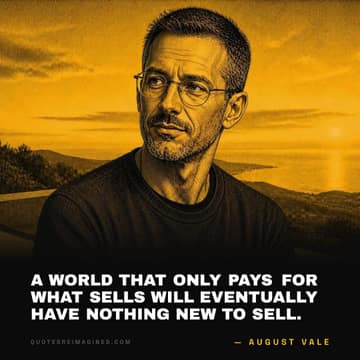
A world that only pays for what sells will eventually have nothing new to sell.
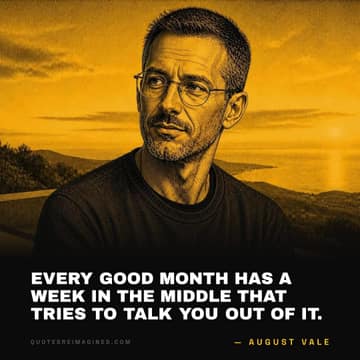
Every good month has a week in the middle that tries to talk you out of it.
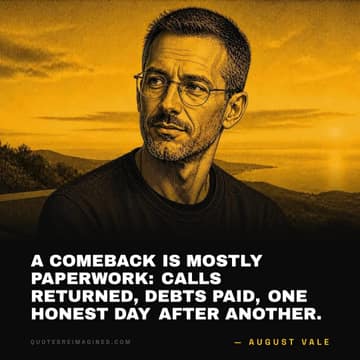
A comeback is mostly paperwork: calls returned, debts paid, one honest day after another.
The fastest way to shrink a public failure is to be seen working the next morning.
Come back like a professional: same time, same place, slightly smarter.
Some cracks mean the house is falling. Most just mean it’s settling.
Nobody knows which Tuesday made the masterpiece. Not even the master.
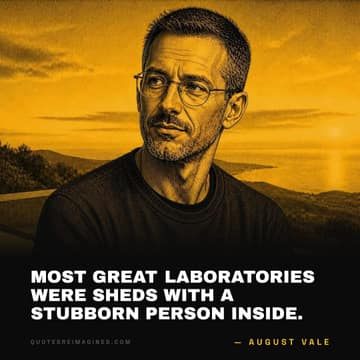
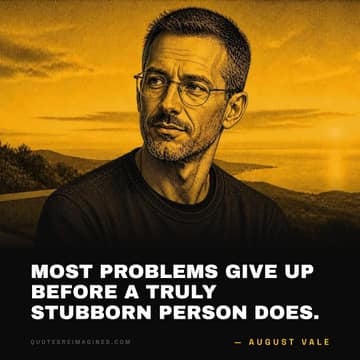
Most great laboratories were sheds with a stubborn person inside.
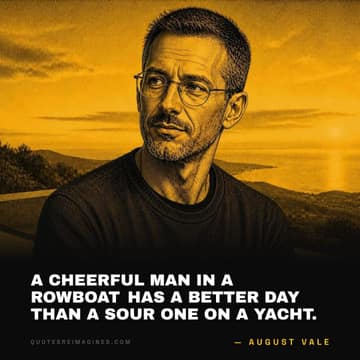
A cheerful man in a rowboat has a better day than a sour one on a yacht.
Your childhood home shrinks a little every visit. The house didn’t change. You did.
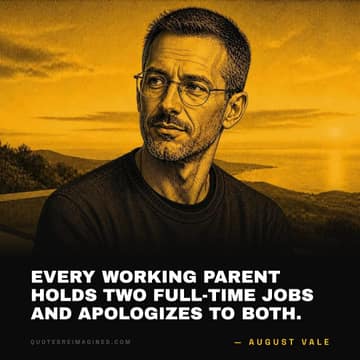
Every working parent holds two full-time jobs and apologizes to both.
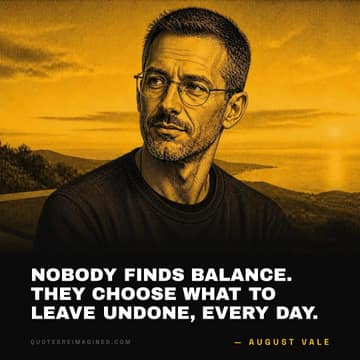
Nobody finds balance. They choose what to leave undone, every day.
The habit you’re proudest of is one you nearly quit in week two.
Fitness climbs like a mountain road: plenty of downhill on the way up.
The habit you build for a small reason gets drafted for a big one later.
Every health goal comes with a second list: what it will cost. Write that one too.
The opponent you meet every morning is wearing your pajamas.
Up close, a life looks like errands. From high enough, you can see the road.
Every when-I-retire is a promise signed by someone who won’t be there to keep it.
Love someone long enough and every late phone call sounds like news.
Improve yourself the way you’d stock a pantry: for whoever comes knocking.
Your family pays for your ambition too. Ask them before you spend it.
Sadness sings at the top of its lungs. Happiness mostly hums.
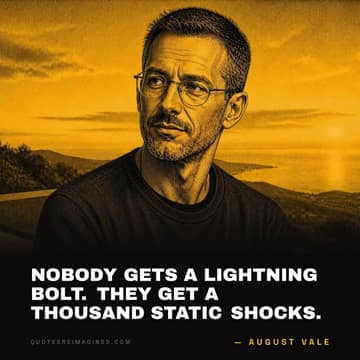
Nobody gets a lightning bolt. They get a thousand static shocks.
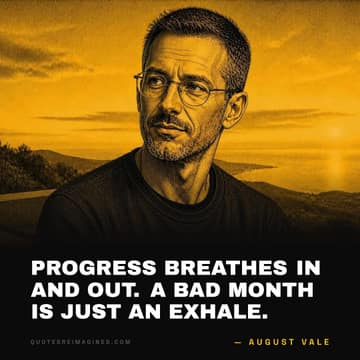
Progress breathes in and out. A bad month is just an exhale.
The cure for discouragement is usually waiting back at the workbench.
Learn one thing the slow way. Every lesson after it comes at a discount.
Belief in yourself comes and goes. Yesterday’s finished work is still there in the morning.
A calling never checks the salary. Somebody in the house had better.
Every company needs one dreamer and one person who reads the contracts.
No honest hour is wasted. Some just get paid in a later currency.
Nobody signs up for a life’s work. They sign up for a small question that won’t let go.
Persistence gets you halfway. Other people’s goodwill carries you the rest.
The try that works usually feels exactly like the ones that didn’t.
Water looks like nothing is happening right up until it boils.
The last mile is uphill on purpose. It checks who really wanted it.
Most of what hurt you at twenty reads like someone else’s diary by fifty.
Old photos show the haircut, never the worry. This year will be the same.
The years you remember best were never planned to be memorable.
A life’s work is usually one stubborn hope, tried again in different decades.
Go easy on your younger self. You’re practically strangers now.
Some days the only goal is to still be standing at sunset. That counts.
History’s best work was mostly done by people checking the price of bread.
Money is rarely the missing piece. It’s just the easiest one to blame.
The hours you’d never think to invoice are usually your best ones.
In Marie Curie’s own words
The life of a great scientist in his laboratory is not, as many may think, a peaceful idyll. More often it is a bitter battle with things, with one's surroundings, and above all with oneself.
Between the days of fecund productivity are inserted days of uncertainty when nothing seems to succeed, and when even matter itself seems hostile; and it is then that one must hold out against discouragement.
You cannot hope to build a better world without improving the individuals. To that end each of us must work for his own improvement, and at the same time share a general responsibility for all humanity, our particular duty being to aid those to whom we think we can be most useful.
Pierre Curie4 quotes
And we were very happy in spite of the difficult conditions under which we worked.
And from time to time, as happens to those who know the value of sharing a common life, the fear of the irreparable touched our minds.
A great discovery does not leap completely achieved from the brain of the scientist, as Minerva sprang, all panoplied, from the head of Jupiter; it is the fruit of accumulated preliminary work.
Our society, in which reigns an eager desire for riches and luxury, does not understand the value of science.
Pierre Curie (Autobiographical Notes)11 quotes
Many of our feelings change with the years, and, when faded away, may seem altogether strange; incidents lose their momentary interest and may be remembered as if they have occurred to some other person. But there may be in a life some general direction, some continuous thread, due to a few dominant ideas and a few strong feelings, that explain the life and are characteristic of a human personality.
This method could not be greatly productive, yet it was not without results. I acquired the habit of independent work, and learned a few things which were to be of use later on.
My persistent efforts were not in vain.
Neither of us could foresee that in beginning this work we were to enter the path of a new science which we should follow for all our future.
We had no money, no suitable laboratory, no personal help for our great and difficult undertaking.
Yet it was in this miserable old shed that we passed the best and happiest years of our life, devoting our entire days to our work.
But I shall never be able to express the joy of the untroubled quietness of this atmosphere of research and the excitement of actual progress with the confident hope of still better results. The feeling of discouragement that sometimes came after some unsuccessful toil did not last long and gave way to renewed activity.
My view is that in the education of children the requirement of their growth and physical evolution should be respected, and that some time should be left for their artistic culture.
I have been frequently questioned, especially by women, how I could reconcile family life with a scientific career. Well, it has not been easy; it required a great deal of decision and of self-sacrifice.
However, things always ended in arranging themselves, thanks to our persistence and to the good will we met.
Humanity, surely, needs practical men who make the best of their work for the sake of their own interests, without forgetting the general interest. But it also needs dreamers, for whom the unselfish following of a purpose is so imperative that it becomes impossible for them to devote much attention to their own material benefit.