Seneca
Stoic · ~4 BC–65 ADRoman Stoic philosopher, statesman and dramatist who advised the emperor Nero. His Letters to Lucilius and On the Shortness of Life are still read as practical guides to living.

















































































































Seneca
Stoic · ~4 BC–65 AD · Stoic philosopher and adviser to Nero
Roman Stoic philosopher, statesman and dramatist who advised the emperor Nero. His Letters to Lucilius and On the Shortness of Life are still read as practical guides to living.
- Quotes
- 115
- Vale lines
- 200
Reimagined by August Vale
200 new lines Vale wrote after Seneca and another thinker. Tap one to see both originals.
Every want is a debt. The rich man is the one who stopped borrowing.
Wealth is what’s left when you stop wanting, counting, and comparing.
Health is a savings account that only accepts deposits made today.
Stop debating the person you’ll become. Life is leaving while you argue.
The bravest thing you can do is stop lying to yourself about what scares you.
You don’t run out of time. You spend it on someone else’s dream.
Anger makes you work overtime for the person you’re angry at.
Hold yourself to the rule. Give everyone else the exception.
Forever would make everything cheap. The ending is what sets the price.
A calculated risk means you did the math. Most people stop at the worrying.
A big chance you aren’t ready for is just a very public exam.
Losing asks for nerve. Winning asks for restraint, and far fewer people practice that one.
Enjoy your luck like a rental. Build like it’s due back Monday.
Sleep like a soldier home from the watch: all the way down, and without apology.
Run for the train if you must. Just don’t let your thoughts run after it.
Tired eyes read the same page three times and blame the author.
A good night’s sleep is the only overnight success that’s real.
Being well rested is the most underrated kind of good manners.
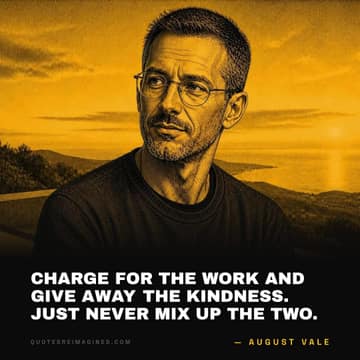
Charge for the work and give away the kindness. Just never mix up the two.
Be careful what you can afford. It tends to become what you need.
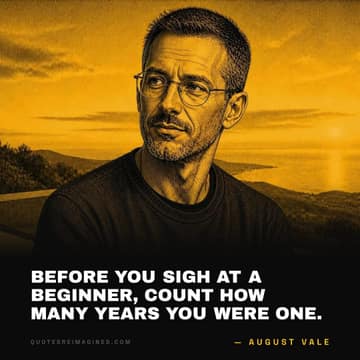
Before you sigh at a beginner, count how many years you were one.
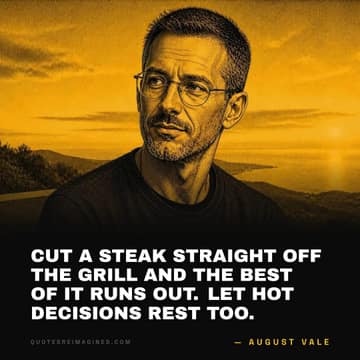
Cut a steak straight off the grill and the best of it runs out. Let hot decisions rest too.
There’s no such thing as spare time. Only time nobody has claimed yet.
Every age thinks it invented being busy. The Romans were already complaining.
A smooth year can’t write you a reference. Only a rough one has watched you work.
After a failure, everyone has advice. Listen to the ones with a failure of their own.
Nobody is unsinkable. Good sailors just know where the buckets are.
Bad weather only tests the knots. You tied them on the sunny days.
Pick the teacher who makes you feel slow, not the one who makes you feel clever.
Some of your best teachers will be younger than your car. Listen anyway.
Thank the teacher who was hard on you. They were betting on someone you hadn’t met yet.
Everyone wants a mentor. Few are the kind of student worth an afternoon.
If you need to be the richest person in the room, you’ll keep choosing smaller rooms.
A cheerful man in a rowboat has a better day than a sour one on a yacht.
Love your own chair and thrones start to look uncomfortable.
A family name is a head start or a headwind. Nobody gets to skip the running.
A tantrum outlasts any lecture and folds for a hug. True at three, true at sixty.
Kids learn to read a parent’s temper long before they learn to read.
The in-law you were warned about is often the first one to show up when it counts.
Marry someone whose habits you’d be glad to catch. You will catch them.
Raise children as a gift, not a loan. Nobody hugs their lender.
Tell a beginner what went right first. They already know what went wrong.
Do favors for the thank-you and you’ll spend your life feeling underpaid.
Never tell a friend half a secret. You’ve handed them the box and kept the key.
A habit that knows it will be reviewed tonight behaves better at noon.
Do the terrifying thing forty times and it turns into the boring thing.
Walk with a friend and every excuse has to get past two people.
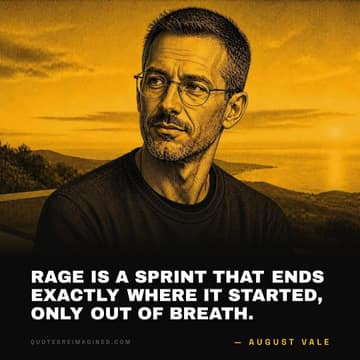
Rage is a sprint that ends exactly where it started, only out of breath.
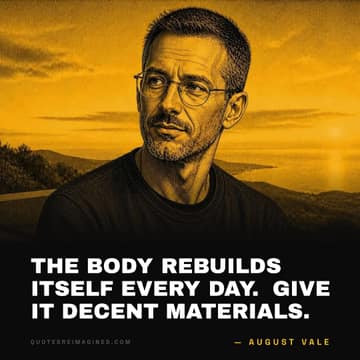
The body rebuilds itself every day. Give it decent materials.
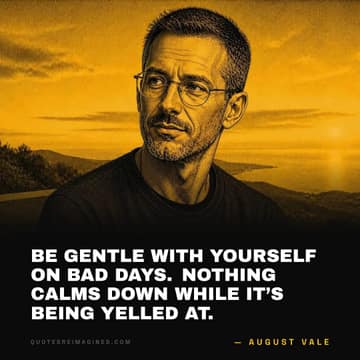
Be gentle with yourself on bad days. Nothing calms down while it’s being yelled at.
Most of us don’t choose our portions. We copy the plate across the table.
A break taken before the crash costs five minutes. One taken after costs a week.
Bad habits never charge you up front. They send the bill at fifty.
Death is the one exam everybody passes and nobody can study for.
If birthdays counted down instead of up, nobody would waste one.
Call the act bad and they’ll fix it. Call the person bad and they’ll prove you right.
Don’t make people ask. Asking often costs them more than the help is worth.
Some sentences can’t be unsaid. Those are the ones anger likes best.
Kindness is a slow siege. Most walls come down if you just keep camping outside.
Never hand out a sentence while your pulse is still writing it.
Ingratitude is the tax on generosity. Keep paying it. The business is still good.
Design your kindness around the cheats and only cheats will stay.
Keep a list of everything you’ve been forgiven for. It makes a short fuse very long.
Most of what you know about people you learned from someone who didn’t check.
Feuds don’t end by treaty. They end when one person quietly changes their mind.
Small irritations are a luxury. Real trouble never has time for them.
A full bookshelf proves you shop. Only the margins prove you read.
Happiness is what it feels like when your calendar agrees with your conscience.
Few of us think of the good idea first. All of us can recognize it when it walks in.
Announce you’re certain and the people who know better go quiet.
Laugh at the world’s mess if you must. Mourning it is how you resign.
We fear like we’re made of glass and want like we’re made of time.
Your trouble isn’t new. That’s the good news: the exits are already marked.
Witnesses can clear your name. Only your conscience can let you sleep.
You never find out you’re iron until something swings at you.
Want nothing and nobody can bribe you, threaten you, or sell you an extended warranty.
The people who needed the most second chances are often the stingiest with them.
Humiliate someone in public and you cure them of caring what anyone thinks.
A loyal friend who groans at everything still drains the room.
The second-smartest person in any room is the one who’ll take a note.
A mentor shortens the road. A flatterer only makes it feel shorter.
Big enough to stretch you, small enough to start. That’s the right size for a goal.
The competitor to fear isn’t watching you. They’re busy getting better.
Losing the wrong job is a promotion that arrived in a bad mood.
The bigger your name, the closer to the front you should stand.
The applause is for the result. The respect is for the recovery.
Fail once at something that matters and the small failures stop scaring you.
The surest way to lose a year is to spend it trying to add one.
Everyone gets the same ending. The difference is the evidence left behind.
Your phone is the most expensive thing you own. It bills in hours.
Somewhere tonight, someone would give anything for the evening you’re about to waste.
Count the Saturdays you probably have left. Then try wasting one.
Old books are the only way to live in more than one century.
Of all the centuries on offer, you got this one. Don’t spend it complaining about the seat.
You were born with one appointment already booked. The rest of the calendar is yours.
Every life is unfinished. That’s not a flaw. It’s the format.
Children build sandcastles knowing the tide is coming. Build like that.
When you finally have the time, make sure you still have the people.
Waiting until things settle down is how things settle down without you.
Medicine keeps adding years. Nobody has invented what to do with them.
A lifetime is plenty for one great thing and nowhere near enough for everything.
Your parents were patient with your first thousand questions. Be patient with their hundredth story.
Everyone is spending from an account that never shows the balance.
Revenge is the same wrong, arriving second and calling itself justice.
It’s hard to stay angry at someone while you’re making them a sandwich.
Someone who only tells you things in a whisper isn’t confiding. They’re recruiting.
Trust is the day you stop drafting replies to things they haven’t said.
Whoever forgives first gets to decide what the story was about.
People may forgive what you said in anger. They never forget that you could say it.
Fortunes are mostly built by stepping around holes, not leaping over them.
Anyone can look rich in a good year. Wealth is what’s left after a bad one.
Spend on what you touch every day. Save on what you show once a year.
Decide what you can afford to lose before anyone else decides it for you.
The calmest investors read old books. Every panic is a rerun.
Owing and owning are one letter apart and a whole life apart.
Choose the life, then do the math. Most people do the math and call it a life.
Remember what it was like to have nothing. It keeps you careful and kind at once.
Greed is mostly a disease of people who already have enough.
In Seneca’s own words
Nothing is sufficient for covetous desire, but Nature can be satisfied even with scant measure.
Reflect that length of time is not the greatest of blessings; make the best of your time, however short it may be; even if the day of your death be postponed, your happiness will not be increased, for life is merely made longer, not pleasanter, by delay.
The man who is not angry remains unshaken by injury: he who is angry has been moved by it.
We should choose for our friends men who are, as far as possible, free from strong desires: for vices are contagious, and pass from a man to his neighbour, and injure those who touch them.
It is not a good thing to live, but to live well.
Fire tries gold, misfortune tries brave men.
The invulnerable is not that which is never struck, but that which is never wounded.
A man will never be well off to whom it is a torture to see any one better off than himself.
The mind is strong enough to bear those evils for which it is prepared.
Life is long enough, if you know how to use it.
You fear everything, like mortals as you are, and yet you desire everything as if you were immortals.
Anger often comes to us, but we often go to it.
Other sources5 quotes
Minor Dialogues76 quotes
I have placed every good thing within your own breasts: it is your good fortune not to need any good fortune.
Would not every man wish to lay aside anger when he sees that it begins by injuring himself?
The happy man, therefore, is he who can make a right judgment in all things: he is happy who in his present circumstances, whatever they may be, is satisfied and on friendly terms with the conditions of his life.
Why need we wonder if those who begin to climb a steep path do not succeed in ascending it very high? yet, if you be a man, look with respect on those who attempt great things, even though they fall.
Our mind ought always to be on the alert, and while it ought never to fear what is certain to happen, it ought always to be ready for what may happen at any time.
The man who will tell you nothing save in secret hardly tells you anything at all.
If you want to find out the truth about anything, commit the task to time: nothing can be accurately discerned at a time of disturbance.
A good man delights in receiving advice: all the worst men are the most impatient of guidance.
Let us not moderate anger, but get rid of it altogether: what can moderation have to do with an evil habit?
Let us therefore inquire, not what is most commonly done, but what is best for us to do, and what will establish us in the possession of undying happiness, not what is approved of by the vulgar, the worst possible exponents of truth.
Know then that every station of life is transitory, and that what has ever happened to anybody may happen to you also.
Since Nature allows us to commune with every age, why do we not abstract ourselves from our own petty fleeting span of time, and give ourselves up with our whole mind to what is vast, what is eternal, what we share with better men than ourselves?
You are a great man; but how am I to know it, if fortune gives you no opportunity of showing your virtue?
Nothing becomes one who inflicts punishment less than anger, because the punishment has all the more power to work reformation if the sentence be pronounced with deliberate judgment.
Virtue alone is lofty and sublime, nor is anything great which is not at the same time tranquil.
Revenge and retaliation are words which men use and even think to be righteous, yet they do not greatly differ from wrong-doing, except in the order in which they are done: he who renders pain for pain has more excuse for his sin; that is all.
Good men are at peace among themselves; bad ones are equally mischievous to the good and to one another.
Think, above all, how base and hateful is the power of doing mischief, and how unnatural in man, by whose kindness even fierce animals are rendered tame.
Let us look back upon our own youth, and think how often we then were too slothful in our duty, too impudent in our speech, too intemperate in our cups.
Nothing, I think, is more admirable than that those who are in high places should pardon many shortcomings in others, and have to ask it for none of their own.
If any one pities the dead, he ought also to pity those who have not been born.
Too much pleasure is hurtful: but with virtue we need fear no excess of any kind, because moderation is contained in virtue herself.
The hardness of flint is known to none so well as to those who strike it.
How far happier is he who is indebted to no man for anything except for what he can deprive himself of with the greatest ease!
Let a man, then, obtain as many books as he wants, but none for show.
Add to this that he who laughs at the human race deserves better of it than he who mourns for it, for the former leaves it some good hopes of improvement, while the latter stupidly weeps over what he has given up all hopes of mending.
You need not think, because sometimes they call for death, that their lives are long: their folly torments them with vague passions which lead them into the very things of which they are afraid: they often, therefore, wish for death because they live in fear.
We shall never lack causes of anxiety, either pleasurable or painful: our life will be pushed along from one business to another: leisure will always be wished for, and never enjoyed.
External circumstances have very little importance either for good or for evil: the wise man is neither elated by prosperity nor depressed by adversity; for he has always endeavoured to depend chiefly upon himself and to derive all his joys from himself.
It is for this that we have all been brought up: every one who is brought into life is intended to die.
I imagine, also, that few men are less willing to grant pardon, than those who have often had to beg it for themselves.
Anger brings grief to a father, divorce to a husband, hatred to a magistrate, failure to a candidate for office. It is worse than luxury, because luxury enjoys its own pleasure, while anger enjoys another’s pain.
You should know that good men ought to act in like manner, so as not to fear troubles and difficulties, nor to lament their hard fate, to take in good part whatever befalls them, and force it to become a blessing to them.
Do not, I beg you, dread those things which the immortal gods apply to our minds like spurs: misfortune is virtue’s opportunity.
We ought to free our minds of suspicion and mistrust, those most untrustworthy causes of anger.
Let our undertakings, therefore, be neither petty nor yet presumptuous and reckless: let our hopes not range far from home: let us attempt nothing which if we succeed will make us astonished at our success.
Do not form your judgment by one hour, or one day: consider the whole tendency of your mind: even though you have done no evil, yet you are capable of doing it.
It is, I repeat, the setting a great value on trifles that is the cause of your anger and madness.
Anger will cease, and become more gentle, if it knows that every day it will have to appear before the judgment seat.
To reprove a man when he is angry is to add to his anger by being angry oneself.
Life is a matter which does not admit of waste, and we have no spare time to throw away.
In fine, my riches belong to me, you belong to your riches.
What you desire, to be undisturbed, is a great thing, nay, the greatest thing of all, and one which raises a man almost to the level of a god.
Though he may continue loyal and friendly towards you, still one’s peace of mind is destroyed by a comrade whose mind is soured and who meets every incident with a groan.
Neither let us envy those who are in high places: the heights which look lofty to us are steep and rugged.
I shall never be ashamed to quote a good saying because it comes from a bad author.
Indeed, if the number of every man’s future years could be laid before him, as we can lay that of his past years, how anxious those who found that they had but few years remaining would be to make the most of them?
I never have trusted in Fortune, even when she seemed most peaceful.
It is, therefore, a great consolation to reflect that what has happened to us has happened to every one before us and will happen to every one after us.
Soldiers divide their watches, and those who have just returned from active service are allowed to sleep the whole night undisturbed. We must humour our minds and grant them rest from time to time, which acts upon them like food, and restores their strength.
To rejoice and be glad is the proper and natural function of virtue: it is as much beneath her dignity to be angry, as to mourn: now, sorrow is the companion of anger, and all anger ends in sorrow, either from remorse or from failure.
What is more restful than a mind at peace, and what more toilsome than anger?
Games also will be useful: for moderate pleasure relieves the mind and brings it to a proper balance.
Suspicion will never lack grounds: what we want is straightforwardness, and a kindly interpretation of things.
Let us also reflect, how much credit the tale of our forgiveness will confer upon us, how many men may be made into valuable friends by forgiveness.
Other vices affect our judgment, anger affects our sanity: others come in mild attacks and grow unnoticed, but men’s minds plunge abruptly into anger.
Be prepared to submit to much.
A man should be unbiassed and not to be conquered by external things: he ought to admire himself alone, to feel confidence in his own spirit, and so to order his life as to be ready alike for good or for bad fortune.
Men set the greatest store upon presents or pensions, and hire out their work, their services, or their care in order to gain them: no one values time: they give it much more freely, as though it cost nothing.
Why! you are busy, but life is hurrying on: death will be here some time or other, and you must attend to him, whether you will or no.
Life, it is thanks to Death that I hold thee so dear.
Virtue is free, inviolable, not to be moved, not to be shaken, and so hardened against misfortunes that she cannot be bent, let alone overcome by them.
The nobler a man is by birth, by reputation, or by inheritance, the more bravely he should bear himself, remembering that the tallest men stand in the front rank in battle.
Every one when he calls himself innocent looks rather to external witnesses than to his own conscience.
The sword of justice is ill-placed in the hands of an angry man.
Yet there is nothing so hard and difficult that the mind of man cannot overcome it, and with which unremitting study will not render him familiar, nor are there any passions so fierce and independent that they cannot be tamed by discipline.
The evils from which we suffer are curable, and since we were born with a natural bias towards good, nature herself will help us if we try to amend our lives.
In fine, the culture of any of the virtues is easy, while vices require a great expense.
A man ought to be neither robber nor victim, neither tender-hearted nor cruel.
How foolish to be angry with such things as these, which neither deserve nor feel our anger!
A great part of mankind is not angry with sins, but with sinners.
Always believe that something will occur to offend you. A pilot never spreads all his canvas abroad so confidently as not to keep his tackle for shortening sail ready for use.
In order, therefore, that the mind may be at peace, it ought not to be hurried hither and thither, nor, as I said before, wearied by labour at great matters, or matters whose attainment is beyond its strength.
Even those who are naturally crabbed and wild will yield to caresses: no creature continues either angry or frightened if you pat him.
It is useful for a man to understand his disease, and to break its strength before it becomes developed.
Even if you gain nothing by your adjournment, still what you do after it will appear to be the result of mature deliberation, not of anger.
On Benefits22 quotes
It is the property of a great and good mind to covet, not the fruit of good deeds, but good deeds themselves, and to seek for a good man even after having met with bad men.
To help, to be of service, is the part of a generous and noble mind; he who gives acts like a god, he who demands repayment acts like a money-lender.
Nothing is lost because he who loses had counted the cost before.
The best man is he who gives readily, never asks for any return, and is delighted when the return is made, because, having really and truly forgotten what he gave, he receives it as though it were a present.
It is not enough to wish a man well, without doing him good; nor is it enough to do him good without wishing him well.
Men do not change from the best to the worst; even in becoming bad, he would necessarily retain some traces of goodness; virtue is never so utterly quenched as not to imprint on the mind marks which no degradation can efface.
Very few men are led by their own reason: those who come next to the best are those who return to the right path in consequence of advice; and these we must not deprive of their guide.
The man who while he gives thinks of what he will get in return, deserves to be deceived.
The path of virtue is closed to no one, it lies open to all; it admits and invites all, whether they be free-born men, slaves or freed-men, kings or exiles; it requires no qualifications of family or of property, it is satisfied with a mere man.
We ought, therefore, to divine every man's wishes, and when we have discovered them, to set him free from the hard necessity of asking; you may be sure that a benefit which comes unasked will be delightful and will not be forgotten.
I also declare that happiness is impossible without virtue.
It is better to benefit the bad as well, for the sake of benefiting the good, than to stint the good for fear of benefiting the bad.
Be not deceived in pursuing this plan; vice, if you do not too soon begin to hate it, will yield to virtue.
Whom would you admire more than he who governs himself and has himself under command?
The second best form of virtue is to be willing and able to take advice.
As you can bear yourself wisely both in doubtful, in prosperous, and in adverse circumstances, by showing prudence in doubtful cases, courage in misfortune, and self-restraint in good fortune, so in all circumstances you can make yourself useful to your friend.
Bad men are overcome by unwearying goodness, nor does any one receive kindness in so harsh and hostile a spirit as not to love good men even while he does them wrong, when they lay him under the additional obligation of requiring no return for their kindness.
How sweet, how precious is a gift, when he who gives does not permit himself to be thanked, and when while he gives he forgets that he has given!
Just as it is the noblest of acts to save men from harm against their will, so it is but hatred, under the mask of civility, to grant what is harmful to those who ask for it.
It is no proof of a great mind to give and to throw away one's bounty; the true test of a great mind is to throw away one's bounty and still to give.
Nature herself cannot recall what she has given. She may cease to bestow benefits, but cannot take them away: a man who dies, yet has lived; a man who becomes blind, nevertheless has seen.
Too loud reproaches have often dispelled a modesty which might have borne good fruit. No man fears to be that which all men see that he is; when his fault is made public, he loses his sense of shame.