François de La Rochefoucauld
Moralist · 1613–1680French nobleman and writer whose Maxims, brief and unsentimental, are among the sharpest observations ever made about self-interest and vanity.





























































































































François de La Rochefoucauld
Moralist · 1613–1680 · French author of the Maxims
French nobleman and writer whose Maxims, brief and unsentimental, are among the sharpest observations ever made about self-interest and vanity.
- Quotes
- 81
- Vale lines
- 126
Reimagined by August Vale
126 new lines Vale wrote after La Rochefoucauld and another thinker. Tap one to see both originals.
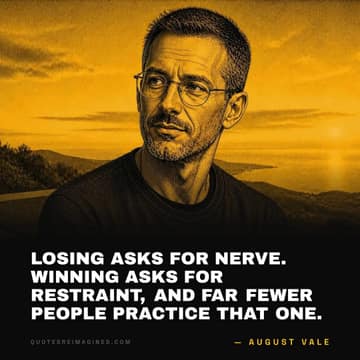
Losing asks for nerve. Winning asks for restraint, and far fewer people practice that one.
Give an idle mind a body to watch and it will find a disease by Thursday.
A scattered mind is a radio between stations: plenty of signal, no song.
The busy and the idle end the day the same way, unable to say where it went.
Good surgeons keep a list of their complications. Bad ones keep a list of excuses.
Catch your own mistake and it’s a lesson. Let the boss catch it and it’s a meeting.
It’s easy to be brave in a crowd. Try it in the family group chat.
A good editor makes you sound more like yourself, not more like them.
You can’t teach anyone to be original. You can only stop teaching them to be the same.
The more decoration a thing needs, the less its maker trusted it.
If you need to be the richest person in the room, you’ll keep choosing smaller rooms.
Happiness is a small room. It fills up faster than you’d think.
Being liked by everyone is a full-time job with no pay and a lot of bosses.
Comparison can turn a perfectly good kitchen into a project.
Anyone who knows their favorite things is very hard to sell to.
The one who loves more is always the last to notice the ending.
Praise your partner at the party and save the complaints for the car. Most people do it backwards.
Kids are charming because nobody has taught them to act like anyone else yet.
Parents who can’t say no at two end up shouting it at fifteen.
Some family traditions should end with you. Breaking a bad one is its own kind of loyalty.
Everybody has one subject that lights up their face. Find it and the evening begins.
Never tell a friend half a secret. You’ve handed them the box and kept the key.
Hospitality isn’t the menu. It’s noticing who hasn’t been offered a drink.
When someone shares good news, ask one more question before you mention yours.
Your day isn’t stolen. It’s pickpocketed, one tab at a time.
As long as you’re gritting your teeth, the habit is still a guest.
A steady pace looks slow until you count the people who stopped.
Five minutes on the couch can cancel a resolution that took a year to make.
Health is for spending. Nobody keeps it by never taking it out.
Enthusiasm pays for the first week. Something duller has to pay for the rest.
Idleness never says no. It just says later, softly, forever.
Some moderation is wisdom. Some is just a nap with a good excuse.
Chase every health trend at once and you’ll miss the boring one that works.
Your kids are learning what tired adults do with an evening.
We learn to die the way we learned to walk: by watching someone do it well.
Nobody likes being dragged to a conclusion. Everybody likes arriving at one.
Say it clearly. Making people guess what you meant is a small cruelty.
A friend’s flaw you’ve known for years isn’t news. Stop reacting like it is.
We call people good judges of character when they happen to like us.
It’s easy to get close to someone with nothing to hide. There are no locked rooms to tiptoe past.
The fastest way to lose someone is to be certain you never could.
A bad night isn’t a bad marriage. Don’t close the show over one review.
Jealousy is fear of losing them. Use it to treat them better, not to watch them closer.
Be sure you love the person and not just the feeling they give you.
The cheat is always the easiest mark at the table. He’s too busy watching his own hands.
People trust your gloom on sight. Your cheer has to show its papers.
Anything wise can be made to look silly by someone who only came for the laugh.
Great minds have silly ideas too. Fame just gets them a longer shelf life.
Everyone is reasonable. They just measure it with their own ruler.
Most of your talents are waiting for an accident to introduce you.
Sharp gets you through the door. Wide lets you see the room.
Some fights you’re lucky to lose, like the one against the truth about yourself.
Most weeks, the bravest thing you’ll do is say what you actually think.
We shrug at fools. We only seethe at people we secretly rate.
Curiosity takes nerve. Ask enough questions and one of the answers will be about you.
Every closet has one favorite shirt. The rest are understudies.
Jealousy keeps guarding the house long after the love moved out.
Ambition is salt. Without it nothing has flavor. With too much, nothing else does.
Thank your rivals. Nobody else would have made you run that fast.
Everyone at the top is improvising. They just had more rehearsals.
Shortcuts are fast right up until people learn you take them.
Being the sharpest tongue in the meeting is a fast way to lose the vote.
Books teach you the trade. People teach you how to get paid for it.
Death gets its worst reviews from people who are nowhere near it.
Idleness never wins the argument. It just waits for you to sit down.
Every goodbye is a small rehearsal for the big one. Do them gracefully.
Grab at every minute and you’ll miss the hour that mattered.
Everyone is slow at something you’re fast at. Remember that when the line stops moving.
Waste enough hours and you start losing the knack for using them.
Rest is for recovering. Idleness is for avoiding. From the couch they look identical.
Death has taught more philosophy than every classroom combined.
Someone who only tells you things in a whisper isn’t confiding. They’re recruiting.
If someone’s story needs a map, don’t let them lead you anywhere.
Win the argument, but leave them a door. Nobody surrenders into a corner.
The quickest way to calm someone down is to agree with the one thing they got right.
A wise man’s needs fit in one pocket. A fool’s won’t fit in the world.
We haggle over the coffee and sign the mortgage in five minutes.
The hardest money to keep is the money you’ve decided you deserve.
Money tests character the way altitude tests lungs. You find out who trained.
No salary is high enough for someone who’s decided to be unhappy.
In La Rochefoucauld’s own words
Few things are needed to make a wise man happy; nothing can make a fool content; that is why most men are miserable.
Jealousy is always born with love, but does not always die with it.
Our virtues are most frequently but vices disguised.
We are never so easily deceived as when trying to deceive.
It is more necessary to study men than books.
We are always bored by those whom we bore.
Idleness, languishing as she is, does not often fail in being mistress; she usurps authority over all the plans and actions of life; imperceptibly consuming and destroying both passions and virtues.
Our greediness so often troubles us, making us run after so many things at the same time, that while we too eagerly look after the least we miss the greatest.
Those faults are always pardonable that we have the courage to avow.
Maxims72 quotes
When we love too much it is difficult to discover when we have ceased to be beloved.
It is one of the devices of Pride to lower us to raise us; and truly pride transforms itself in a thousand ways, and is never so well disguised and more able to deceive than when it hides itself under the form of humility.
Thousands of people with good qualities are displeasing; thousands pleasing with far less abilities, and why? Because the first wish to appear to be what they are not, the second are what they appear.
Little minds are wounded by the smallest things.
For many reasons we may be disgusted with life, but for none may we despise it.
We find very few people of good sense, except those who are of our own opinion.
We commonly praise the good hearts of those who admire us.
In those who appear gentle it is generally only weakness, which is readily converted into harshness.
We should make it a rule never to have half confidences. They always embarrass those who give them, and dissatisfy those who receive them.
If one appears wise 'tis but because his folly is proportioned to his age and fortune.
We imitate good actions by emulation, and bad ones by the evil of our nature, which shame imprisons until example liberates.
We prefer ourselves always to those with whom we intend to live, and they almost always perceive the preference.
Above all things we should avoid often talking of ourselves and giving ourselves as an example; nothing is more tiresome than a man who quotes himself for everything.
We should avoid far-fetched expressions, expressions hard or forced, and never let the words be grander than the matter.
Our self-love is flattered by all that presents itself to us under the guise of good.
If men only wished to excel by the help of their own talents, and in following their duty, there would be nothing false in their taste or in their conduct.
There are those who avoid our jealousy, of whom we ought to be jealous.
The power which women whom we love have over us is greater than that which we have over ourselves.
The wise man finds it better not to enter the encounter than to conquer.
If we think we love for love's sake we are much mistaken.
Men will freely expose themselves at the beginning of an action, and relax and be easily discouraged if it should last.
Some may be found whose courage is strengthened by small perils, which prepare them to face greater dangers.
Fortune discovers our vices and our virtues, as the light makes objects plain to the sight.
A man to whom no one is pleasing is much more unhappy than one who pleases nobody.
Sincerity is an openness of heart, which shows us what we are, a love of truth, a dislike to deception, a wish to compensate our faults and to lessen them by the merit of confessing them.
It is far safer and more honest to tell nothing than to be silent when we have begun to tell.
It is possible to have a serious turn of mind, and yet to talk pleasantly and cheerfully.
To make society pleasant, it is essential that each should retain his freedom of action.
We should so render a free consent, that in following the opinion of our friends they should believe that they follow ours.
We should readily excuse our friends when their faults are born with them, and they are less than their good qualities.
It is dangerous to seek to be always the leader of the conversation, and to push a good argument too hard, when we have found one.
Gentleness should approve without prejudice what deserves to be approved, follow what deserves to be followed, and take offence at nothing.
We often imitate the same person without perceiving it, and we neglect our own good qualities for the good qualities of others, which generally do not suit us.
Good manners and politeness are proper for all the world.
That which makes us so bitter against those who do us a shrewd turn, is because they think themselves more clever than we are.
We should observe the place, the occasion, the temper in which we find the person who listens to us, for if there is much art in speaking to the purpose, there is no less in knowing when to be silent.
All men want to be different, and to be greater than they are; they seek for an air other than their own, and a mind different from what they possess; they take their style and manner at chance.
Moderation is the languor and sloth of the soul, Ambition its activity and heat.
The greater part of men have qualities which, like those of plants, are discovered by chance.
There are certain faults which placed in a good light please more than perfection itself.
It is never more difficult to speak well than when we are ashamed of being silent.
There is nothing more natural, nor more deceptive, than to believe that we are beloved.
A cunning spirit never goes straight, it endeavours to secure its object by byeways and short cuts. This conduct is soon found out, it always gives rise to distrust and never reaches greatness.
Praise is flattery, artful, hidden, delicate, which gratifies differently him who praises and him who is praised.
We wish to find the guilty, and we do not wish to trouble ourselves in examining the crime.
We are ashamed to own we are jealous, and yet we plume ourselves in having been and being able to be so.
The necessity of dying created all the constancy of philosophers.
The repose of idleness is a magic charm which suddenly suspends the most ardent pursuits and the most obstinate resolutions.
Most frequently we make confidants from vanity, a love of talking, a wish to win the confidence of others, and make an exchange of secrets.
Some are clever only in what does not concern them, and the reverse in all that does.
Satire is at once the most agreeable and most dangerous of mental qualities.
One can be a fool with much wit, and one need not be a fool even with very little wit.
We do not see with the same eyes what does and what does not relate to us.
Complaisance is essential in society, but it should have its limits, it becomes a slavery when it is extreme.
Civility often hides half its understanding, and when it meets with an opinionated man who defends the bad side, spares him the disgrace of giving way.
It would be idle to show how far society is essential to men: all seek for it, and all find it, but few adopt the method of making it pleasant and lasting.
What a tiresome malady is that which forces one to preserve your health by a severe regimen.
The taste changes, but the will remains the same.
The restraint we lay upon ourselves to be constant, is not much better than an inconstancy.
Chance makes us known to others and to ourselves.
The greatest fault of penetration is not that it goes to the bottom of a matter—but beyond it.
One weeps to achieve a reputation for tenderness, weeps to be pitied, weeps to be bewept, in fact one weeps to avoid the disgrace of not weeping!
We help others that on like occasions we may be helped ourselves, and these services which we render, are in reality benefits we confer on ourselves by anticipation.
It is only deceiving ourselves to imagine that death, when near, will seem the same as at a distance, or that our feelings, which are merely weaknesses, are naturally so strong that they will not suffer in an attack of the rudest of trials.
For the rest it is a fact that whatever difference there may be between the peer and the peasant, we have constantly seen both the one and the other meet death with the same composure.
A well regulated mind sees all things as they should be seen, appraises them at their proper value, turns them to its own advantage, and adheres firmly to its own opinions as it knows all their force and weight.
The reason why so few persons are agreeable in conversation is that each thinks more of what he desires to say, than of what the others say, and that we make bad listeners when we want to speak.
To please others we should talk on subjects they like and that interest them, avoid disputes upon indifferent matters, seldom ask questions, and never let them see that we pretend to be better informed than they are.
We know very well that we should not talk about our wives, but we do not remember that it is not so well to speak of ourselves.
We should try to find out what air is natural to us and never abandon it, but make it as perfect as we can. This is the reason that the majority of children please.
Our actions are like rhymed verse-ends (Bouts-Rimes) which everyone turns as he pleases.
We may have a mind, but a narrow one. A mind may be fitted for some things, not for others.