Friedrich Nietzsche
Philosopher · 1844–1900German philosopher who questioned conventional morality and wrote in aphorisms, in books such as Beyond Good and Evil and Twilight of the Idols.




































































Friedrich Nietzsche
Philosopher · 1844–1900 · German philosopher
German philosopher who questioned conventional morality and wrote in aphorisms, in books such as Beyond Good and Evil and Twilight of the Idols.
- Quotes
- 79
- Vale lines
- 114
Reimagined by August Vale
114 new lines Vale wrote after Nietzsche and another thinker. Tap one to see both originals.
Ambition works like a telescope. The far thing gets close and everything nearby disappears.
A sense of humor is a health check. Whatever you can’t joke about has started running things.
Feel better after a walk? That isn’t a coincidence. It’s an instruction.
Look at one thing for a full minute. Most of us haven’t done that since we were six.
Wealth on display is an invitation, and not every guest is a friend.
Whenever you say life’s too short for this, take your own advice.
Hindsight makes every failure look obvious and every success look planned. Believe neither.
Some of the bravest acts on earth are a hand going up in a quiet room.
Anyone can teach the eager. Mastery is making the bored lean in.
An expert’s eye isn’t sharper. It just knows where to look first.
Apprentices who only sweep, sweep forever. Watch the hands while you hold the broom.
Good mentors answer your question with a better one, then wait.
Set your clock by other people’s expectations and you’ll always be running late.
The best houses look lived in. The worst look like they’re waiting for a photographer.
Simple isn’t a style. It’s what’s left when you stop pretending.
A yes from someone who could have said no is worth ten from someone who couldn’t.
Don’t interrupt a child at serious play. It’s the most focused work in the house.
We rarely envy strangers. Envy saves itself for the kid who shared our bedroom.
A teenager’s closed door is a rehearsal for their own front door. Knock.
When someone tells you their trouble, don’t top it. Hardship isn’t a card game.
Talent without gratitude is a brilliant houseguest. Wonderful for an hour, exhausting by Sunday.
Let people finish the joke you’ve already heard. Telling it is the gift.
A generous listener makes everyone at the table a better storyteller.
Take a walk with no destination. The best ideas don’t book appointments.
Cheerfulness needs no reason, which is why it works on the days that have none.
Decide once. A promise you re-debate every morning loses eventually.
Restless energy needs a job. Without one, it goes to work on you.
Ten minutes of walking after dinner beats an hour of guilt about it.
Pick your rivals as carefully as your friends. You’ll end up resembling both.
Everyone says they don’t need praise. Watch their face when it arrives.
Love doesn’t change the facts. It changes which ones you notice first.
Every long friendship has a drawer of small offenses. Never empty it onto the table.
We forgive people for being wrong about us faster than for proving us wrong about them.
Listen to the face. It rarely got the memo about the polite version.
Blunt is easy. Blunt is usually half the truth, said loudly.
We call people good judges of character when they happen to like us.
A good talk ends with both of you holding a thought neither one brought.
Be sure you love the person and not just the feeling they give you.
Some truths are too big for a fact sheet. They only fit inside a story.
People trust your gloom on sight. Your cheer has to show its papers.
Wisdom is knowing which questions to solve and which to just admire.
You never beat a feeling with willpower. You beat it with a bigger feeling.
Not everything needs to be dug up and examined. Some lawns are just for lying on.
Half of what you see in the world is your own face in the window.
When everyone around you drifts, drifting feels like standing still.
We think we’re judges. Mostly we’re lawyers hired by a mood.
We shrug at fools. We only seethe at people we secretly rate.
The truth costs one brave minute. A lie bills you every month after.
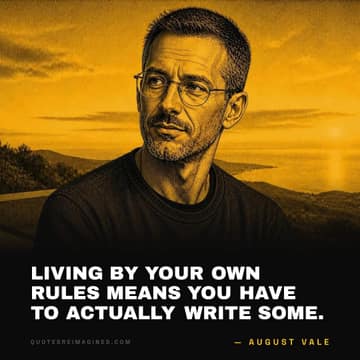
Living by your own rules means you have to actually write some.
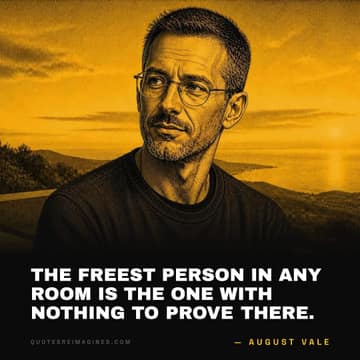
The freest person in any room is the one with nothing to prove there.
Free people keep their promises. They just make fewer of them.
Keep a chair empty at your table. Someone will need it before you know who.
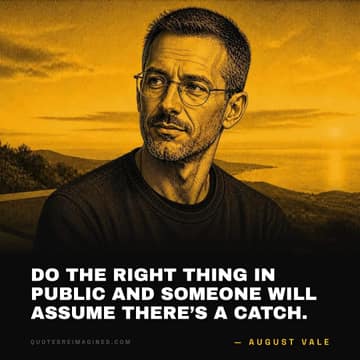
Do the right thing in public and someone will assume there’s a catch.
Some people talk about themselves all night so you’ll never actually meet them.
Nobody is born in charge. They grow into it one hard call at a time.
Your peak shows what you can do. The decline shows who you are.
Everyone at the top is improvising. They just had more rehearsals.
Brag often enough and you end up working for your own press release.
Power doesn’t change people. It just removes the people who used to stop them.
A promotion is a prize for the last job and an exam for the next one.
If something bores you for a decade, the decade still counts.
Learning shows up as patience long before it shows up as answers.
Interrupting tells someone your thought can’t wait and theirs can.
Stare at the past long enough and you start walking toward it.
Over-explaining is how honest people accidentally sound like liars.
Hiding your money can be a show too. Ask who the hiding is for.
Real money freedom starts the day you stop blaming the economy for your habits.
Freedom is heavier than it looks. Plenty of people hand it back.
In Nietzsche’s own words
Every deep thinker is more afraid of being understood than of being misunderstood.
Even the pluckiest among us has but seldom the courage of what he really knows.
If a man knows the wherefore of his existence, then the manner of it can take care of itself.
Without music life would be a mistake.
From the military school of life.—That which does not kill me, makes me stronger.
Insanity in individuals is something rare—but in groups, parties, nations, and epochs it is the rule.
One loves ultimately one's desires, not the thing desired.
Only those thoughts that come by walking have any value.
Beyond Good and Evil48 quotes
Whoever has seen deeply into the world has doubtless divined what wisdom there is in the fact that men are superficial.
What is done out of love always takes place beyond good and evil.
A man who strives after great things, looks upon every one whom he encounters on his way either as a means of advance, or a delay and hindrance—or as a temporary resting-place.
If a man has character, he has also his typical experience, which always recurs.
It is not the strength, but the duration of great sentiments that makes great men.
The great epochs of our life are at the points when we gain courage to rebaptize our badness as the best in us.
Dreadful experiences raise the question whether he who experiences them is not something dreadful also.
A great man? I always see merely the play-actor of his own ideal.
Happiness and virtue are no arguments.
Heavy, melancholy men turn lighter, and come temporarily to their surface, precisely by that which makes others heavy—by hatred and love.
Love brings to light the noble and hidden qualities of a lover—his rare and exceptional traits: it is thus liable to be deceptive as to his normal character.
With his principles a man seeks either to dominate, or justify, or honour, or reproach, or conceal his habits: two men with the same principles probably seek fundamentally different ends therewith.
A soul which knows that it is loved, but does not itself love, betrays its sediment: its dregs come up.
Who has not, at one time or another—sacrificed himself for the sake of his good name?
In what strange simplification and falsification man lives!
Not to cleave to any person, be it even the dearest—every person is a prison and also a recess.
The charm of knowledge would be small, were it not so much shame has to be overcome on the way to it.
Many a peacock hides his tail from every eye—and calls it his pride.
Under peaceful conditions the militant man attacks himself.
The maturity of man—that means, to have reacquired the seriousness that one had as a child at play.
Discovering reciprocal love should really disenchant the lover with regard to the beloved.
Sensuality often forces the growth of love too much, so that its root remains weak, and is easily torn up.
To rejoice on account of praise is in many cases merely politeness of heart—and the very opposite of vanity of spirit.
When we have to change an opinion about any one, we charge heavily to his account the inconvenience he thereby causes us.
The more abstract the truth you wish to teach, the more must you allure the senses to it.
One is punished best for one's virtues.
One no longer loves one's knowledge sufficiently after one has communicated it.
Are you absolutely obliged to straighten at once what is crooked? to stuff every hole with some kind of oakum? Is there not time enough for that?
A man of genius is unbearable, unless he possess at least two things besides: gratitude and purity.
Is it necessary that you should so salt your truth that it will no longer—quench thirst?
The one seeks an accoucheur for his thoughts, the other seeks some one whom he can assist: a good conversation thus originates.
Objection, evasion, joyous distrust, and love of irony are signs of health; everything absolute belongs to pathology.
One may indeed lie with the mouth; but with the accompanying grimace one nevertheless tells the truth.
Is not life a hundred times too short for us—to bore ourselves?
Men of profound sadness betray themselves when they are happy: they have a mode of seizing upon happiness as though they would choke and strangle it, out of jealousy—ah, they know only too well that it will flee from them!
A sign of strong character, when once the resolution has been taken, to shut the ear even to the best counter-arguments. Occasionally, therefore, a will to stupidity.
One must subject oneself to one's own tests that one is destined for independence and command, and do so at the right time.
One must renounce the bad taste of wishing to agree with many people.
One begins to distrust very clever persons when they become embarrassed.
When one trains one's conscience, it kisses one while it bites.
We all feign to ourselves that we are simpler than we are, we thus relax ourselves away from our fellows.
Our vanity is most difficult to wound just when our pride has been wounded.
The will to overcome an emotion, is ultimately only the will of another, or of several other, emotions.
What a person IS begins to betray itself when his talent decreases,—when he ceases to show what he CAN do.
Not only our reason, but also our conscience, truckles to our strongest impulse—the tyrant in us.
To talk much about oneself may also be a means of concealing oneself.
In praise there is more obtrusiveness than in blame.
One does not hate as long as one disesteems, but only when one esteems equal or superior.
Twilight of the Idols23 quotes
It costs a good deal to attain to a position of power; for power stultifies.
Truth to tell man reflects himself in things, he thinks everything beautiful that throws his own image back at him.
People must learn to see; they must learn to think, and they must learn to speak and to write: the object of all three of these pursuits is a noble culture.
Once for all I wish to be blind to many things.—Wisdom sets bounds even to knowledge.
To maintain a cheerful attitude of mind in the midst of a gloomy and exceedingly responsible task, is no slight artistic feat.
Nothing ever succeeds which exuberant spirits have not helped to produce.
Honest things like honest men do not carry their reasons on their sleeve in such fashion.
The best are lacking when selfishness begins to be lacking.
Freedom is the will to be responsible for ourselves.
A man is productive only in so far as he is rich in contrasted instincts; he can remain young only on condition that his soul does not begin to take things easy and to yearn for peace.
To learn to see—to accustom the eye to calmness, to patience, and to allow things to come up to it; to defer judgment, and to acquire the habit of approaching and grasping an individual case from all sides.
One can recognise the hearts that are capable of noble hospitality, by their wealth of screened windows and closed shutters: they keep their best rooms empty.
A man should not play the coward to his deeds. He should not repudiate them once he has performed them.
It is not good form to make a show of everything. That which needs to be proved cannot be worth much.
Idleness is the parent of all psychology.
Help thyself, then everyone will help thee.
The will to a system, shows a lack of honesty.
It is our cheerfulness that people understand least.
In order to acquire intellect, one must be in need of it.
In all speech there lies an element of contempt.
Our virtues are necessarily determined, and are even stimulated, by our weakness.
By seeking the beginnings of things, a man becomes a crab. The historian looks backwards: in the end he also believes backwards.
Art thou one who looks on, or one who puts his own shoulder to the wheel?—Or art thou one who looks away, or who turns aside?...