Samuel Johnson
Writer · 1709–1784English writer, critic and lexicographer who compiled A Dictionary of the English Language, and author of the philosophical tale Rasselas.











































































































Samuel Johnson
Writer · 1709–1784 · English writer and lexicographer
English writer, critic and lexicographer who compiled A Dictionary of the English Language, and author of the philosophical tale Rasselas.
- Quotes
- 50
- Vale lines
- 121
Reimagined by August Vale
121 new lines Vale wrote after Samuel Johnson and another thinker. Tap one to see both originals.
Effortless is what a thousand efforts look like from the stands.
Attention is the first thing a fever takes and the last thing it gives back.
Shopping when you’re sad is asking a cashier to do a friend’s job.
Pay the minimum and one afternoon of shopping becomes a ten-year relationship.
Greed never feels like greed from the inside. It feels like being clever.
Every scam is built on an honest person’s wish to skip a step.
Kids learn to tell time long before they learn what it’s for.
Chew a disappointment and it becomes judgment. Swallow it whole and it becomes bitterness.
Fear of change is usually homesickness for a place that’s already gone.
Practice slow until it’s right. Speed comes later, as the reward.
Nobody knows which Tuesday made the masterpiece. Not even the master.
The hardest lesson for a gifted student is how to be bad at something.
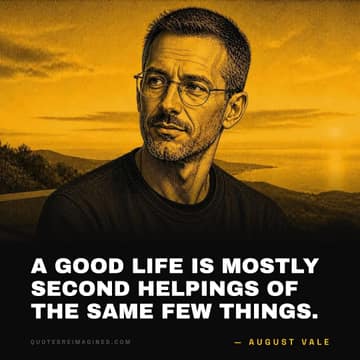
A good life is mostly second helpings of the same few things.
Ask whose whole life you’d trade for, not just their car. The list gets very short.
Couples plan the wedding for a year and the marriage for an afternoon.
The first one to say sorry is rarely the guilty one. It’s the less proud one.
You’ll forgive your parents around the age they were when you judged them hardest.
Someday tell your parents they did fine. They’ve been waiting years for the review.
Before the proposal, survive one road trip, one stomach bug and one tax return together.
Assume everyone is a little lonelier than they look. You’ll be right more often than wrong.
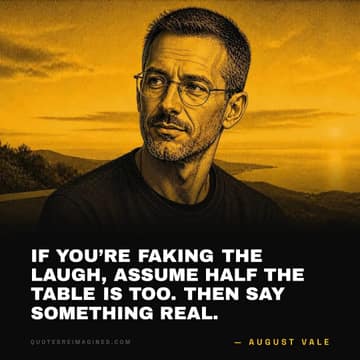
If you’re faking the laugh, assume half the table is too. Then say something real.
A steady pace looks slow until you count the people who stopped.
A limit doesn’t cancel the work. It just cuts it into smaller pieces.
The body rebuilds itself every day. Give it decent materials.
Someone who has given up will always save you a seat on the couch.
Memory is a relay. Sooner or later the last runner sits down. Run your leg anyway.
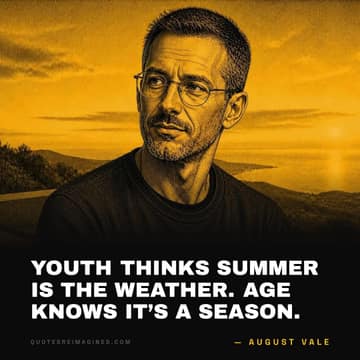
Youth thinks summer is the weather. Age knows it’s a season.
When an old person tells a story twice, they’re telling you which parts mattered.
Before you judge the young, remember what you got away with at their age.
Complaining is second-hand smoke. The people who love you sit closest.
The old call the young reckless. The young call the old scared. They’re describing the same cliff.
Sadness is lonely partly because everyone politely steps around it. Step in.
The moment someone depends on you, your ignorance stops being private.
Some hunger isn’t for food. Somebody on your street is starving for a conversation.
You can’t fix the world, but you can fix one person’s afternoon.
Most of us don’t change our minds. We just take turns being different people.
Truth isn’t hiding. Most of us just search where it’s comfortable.
Being cheerful is partly a chore you do for everyone you live with.
Sorrow is always sure it will last forever. It’s usually wrong.
Imagination is a workshop or a haunted house. Same room, different use.
You lose a little of yourself every year and grow a little back. Trust the repair.
Hope without memory is a guess. With memory, it’s a track record.
Give any year enough distance and it becomes the good old days.
Thank luck for some of your virtue. Temptation never found your address.
Romance writes the checks. Love spends the next forty years covering them.
Make friends older and younger than you. People your age can only tell you about now.
If you can’t lighten someone’s load, at least don’t add yours to it.
Every simple job gets harder with each pair of hands it passes through.
Not knowing is forgivable. Refusing to find out is the real failure.
Skill in the wrong hands just gets the wrong job done faster.
Everything that works for ten people breaks somewhere around fifty.
Lead anything and you’ll be blamed for weather you never ordered.
Most bad decisions are good decisions with the clock set too short.
We look ahead through a magnifying glass and back through the wrong end of a telescope.
Everyone aboard moves at the same speed. That’s why nobody feels the decade go by.
Excess burns bright for an hour. Plain living burns for decades.
In a hundred years nobody will remember your embarrassments. Give it a week and neither should you.
The young have time and no patience. The old have patience and no time. Trade.
Do the hard thinking while the mind is still sharp. It can retire before you do.
Old age hands you the answers right around the time nobody asks the questions.
Some of the best hours of your life will be spent waiting for something else. Notice them.
Pick a craft longer than your life. You’ll never be bored, only interrupted.
Ten years from now, this will look like your youth. Spend it that way.
Choosing to be alone is rest. Being left alone is a wound. Never hand out the second one.
Let the young be wrong for a while. Nobody ever learned a road from the passenger seat.
Youth bets on talent. Age bets on time, and usually collects.
Looks are rented by the season. Character is owned outright.
Every con artist leaves a bill for the next honest stranger.
Trust is the day you stop drafting replies to things they haven’t said.
Money can buy a quiet house. It has never bought a quiet head.
Everyone thinks happiness lives next door. The neighbors think so too.
Living beyond your means is a lie told in monthly installments.
Greed never improvises. Find the incentive and you know the ending.
Live on a street of millionaires and you’ll feel poor by Friday.
Fortune and fame both need feeding. Contentment eats whatever’s on the table.
In Samuel Johnson’s own words
The first years of man must make provision for the last. He that never thinks, never can be wise.
Integrity without knowledge is weak and useless, and knowledge without integrity is dangerous and dreadful.
Great works are performed not by strength, but perseverance; yonder palace was raised by single stones, yet you see its height and spaciousness.
When the clouds of sorrow gather over us, we see nothing beyond them, nor can imagine how they will be dispelled; yet a new day succeeded to the night, and sorrow is never long without a dawn of ease.
To live without feeling or exciting sympathy, to be fortunate without adding to the felicity of others, or afflicted without tasting the balm of pity, is a state more gloomy than solitude; it is not retreat but exclusion from mankind.
Rasselas45 quotes
Age looks with anger on the temerity of youth, and youth with contempt on the scrupulosity of age.
Let us consider that youth is of no long duration, and that in mature age, when the enchantments of fancy shall cease, and phantoms of delight dance no more about us, we shall have no comforts but the esteem of wise men and the means of doing good.
The colours of life in youth and age appear different, as the face of Nature in spring and winter.
Wealth is nothing but as it is bestowed, and knowledge nothing but as it is communicated.
Truth, such as is necessary to the regulation of life, is always found where it is honestly sought.
Some have little power to do good, and have likewise little strength to resist evil.
Ignorance is mere privation, by which nothing can be produced; it is a vacuity in which the soul sits motionless and torpid for want of attraction, and, without knowing why, we always rejoice when we learn, and grieve when we forget.
Let us not imagine evils which we do not feel, nor injure life by misrepresentations.
I have always considered it as treason against the great republic of human nature to make any man’s virtues the means of deceiving him, whether on great or little occasions. All imposture weakens confidence and chills benevolence.
It must happen that one will please more than another; he that knows himself despised will always be envious, and still more envious and malevolent if he is condemned to live in the presence of those who despise him.
We are long before we are convinced that happiness is never to be found, and each believes it possessed by others, to keep alive the hope of obtaining it for himself.
Many were in love with triflers like themselves, and many fancied that they were in love when in truth they were only idle.
When we pursue our end by lawful means, we may always console our miscarriage by the hope of future recompense.
Avarice is a uniform and tractable vice: other intellectual distempers are different in different constitutions of mind; that which soothes the pride of one will offend the pride of another; but to the favour of the covetous there is a ready way—bring money, and nothing is denied.
Whatever facilitates our work is more than an omen; it is a cause of success.
The truth is that no mind is much employed upon the present; recollection and anticipation fill up almost all our moments.
Fear naturally quickens the flight of guilt.
We are long before we are able to think, and we soon cease from the power of acting.
It is our business to consider what beings like us may perform, each labouring for his own happiness by promoting within his circle, however narrow, the happiness of others.
I know that the unhappy are never pleasing, and that all naturally avoid the contagion of misery.
Perhaps if we speak with rigorous exactness, no human mind is in its right state. There is no man whose imagination does not sometimes predominate over his reason who can regulate his attention wholly by his will, and whose ideas will come and go at his command.
The old man trusts wholly to slow contrivance and gradual progression; the youth expects to force his way by genius, vigour, and precipitance.
I have been lately convinced that quiet is not the daughter of grandeur or of power; that her presence is not to be bought by wealth nor enforced by conquest.
Whoever has many to please or to govern must use the ministry of many agents, some of whom will be wicked and some ignorant, by some he will be misled and by others betrayed.
Ignorance, when it is voluntary, is criminal; and he may properly be charged with evil who refused to learn how he might prevent it.
Distance has the same effect on the mind as on the eye; and while we glide along the stream of time, whatever we leave behind us is always lessening, and that which we approach increasing in magnitude.
Flatter not yourself with contrarieties of pleasure. Of the blessings set before you make your choice, and be content.
In general, those parents have most reverence who most deserve it, for he that lives well cannot be despised.
It is evident that as any man acts in a wider compass he must be more exposed to opposition from enmity or miscarriage from chance.
When the desultory levity of youth has settled into regularity, it is soon succeeded by pride ashamed to yield, or obstinacy delighting to contend.
Consider the state of mankind, and inquire how few can be supposed to act upon any occasions, whether small or great, with all the reasons of action present to their minds.
Man cannot so far know the connection of causes and events as that he may venture to do wrong in order to do right.
By degrees the reign of fancy is confirmed; she grows first imperious and in time despotic. Then fictions begin to operate as realities, false opinions fasten upon the mind, and life passes in dreams of rapture or of anguish.
Perpetual levity must end in ignorance; and intemperance, though it may fire the spirits for an hour, will make life short or miserable.
What can be expected but disappointment and repentance from a choice made in the immaturity of youth, in the ardour of desire, without judgment, without foresight, without inquiry after conformity of opinions, similarity of manners, rectitude of judgment, or purity of sentiment?
To judge rightly of the present, we must oppose it to the past; for all judgment is comparative, and of the future nothing can be known.
It is the care of a very great part of mankind to conceal their indigence from the rest. They support themselves by temporary expedients, and every day is lost in contriving for the morrow.
The invitations by which they allure others to a state which they feel to be wretched, proceed from the natural malignity of hopeless misery.
When you feel that your own gaiety is counterfeit, it may justly lead you to suspect that of your companions not to be sincere.
How comfortless is the sorrow of him who feels at once the pangs of guilt and the vexation of calamity which guilt has brought upon him!
To hear complaints is wearisome alike to the wretched and the happy; for who would cloud by adventitious grief the short gleams of gaiety which life allows us, or who that is struggling under his own evils will add to them the miseries of another?
Our minds, like our bodies, are in continual flux; something is hourly lost, and something acquired. To lose much at once is inconvenient to either, but while the vital power remains uninjured, nature will find the means of reparation.
Of the present state, whatever it be, we feel and are forced to confess the misery; yet when the same state is again at a distance, imagination paints it as desirable.
The young man, who intends no ill, believes that none is intended, and therefore acts with openness and candour; but his father; having suffered the injuries of fraud, is impelled to suspect and too often allured to practise it.
If we act only for ourselves, to neglect the study of history is not prudent. If we are entrusted with the care of others, it is not just.