Charlie Munger
Investor · 1924–2023American investor and vice chairman of Berkshire Hathaway, Warren Buffett's long-time partner, known for thinking in mental models.




























































Charlie Munger
Investor · 1924–2023 · Buffett's partner at Berkshire Hathaway
American investor and vice chairman of Berkshire Hathaway, Warren Buffett's long-time partner, known for thinking in mental models.
- Quotes
- 40
- Vale lines
- 102
Reimagined by August Vale
102 new lines Vale wrote after Munger and another thinker. Tap one to see both originals.
Anger makes you work overtime for the person you’re angry at.
Pull bad news fast, like a tooth. Pour good news slowly, like wine.
Every minute spent arguing with the referee is a minute the other team plays alone.
Every business is a bet that you understand somebody better than anyone else has bothered to.
The cure for distraction isn’t more willpower. It’s a more interesting question.
A fair price is one both sides could explain to their mother.
Pay full price for good advice and you might actually take it.
Pay for speed and you’ll get it, along with everything speed breaks.
Not every loss is a lesson. Some are just weather. Don’t spend a year interrogating the rain.
Study your heroes closely enough to find their mistakes. That’s where your own work begins.
Find a mentor ten years ahead, not fifty. You can still see their footprints.
Two average skills nobody else combines beat one great skill everybody has.
Skill is the slowest way to get somewhere and the only way to stay there.
A child forgets the broken toy and remembers the broken promise.
Kids don’t need a perfect parent. They need the same one every day.
Hand a kid something fragile and watch them grow two inches.
Reliable people rarely get thanked, because nothing ever goes wrong around them.
Talent gets you the first call. Reliability gets you the second.
Habits are the government you never voted for. Hold an election.
Ask what would wreck your health, then simply don’t do that.
Pick your boss the way you’d pick a teacher, because that’s what they’ll be.
A relationship is a stack of kept promises. Pull out enough and the roof comes down.
Trust is the one thing in a relationship you can’t buy a second copy of.
Bitterness is a souvenir from a trip you hated. Why keep it on the mantel?
The nearest fact isn’t the truest one. It’s just the one lying on top.
Every subject worth knowing has a boring chapter guarding the good ones.
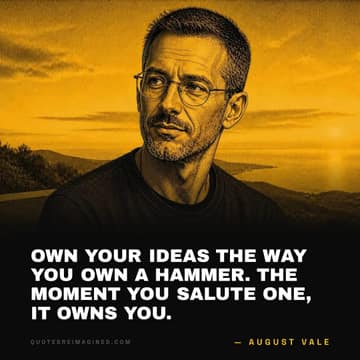
Own your ideas the way you own a hammer. The moment you salute one, it owns you.
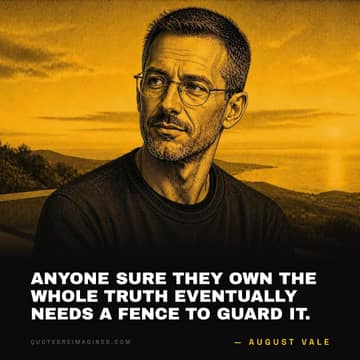
Anyone sure they own the whole truth eventually needs a fence to guard it.
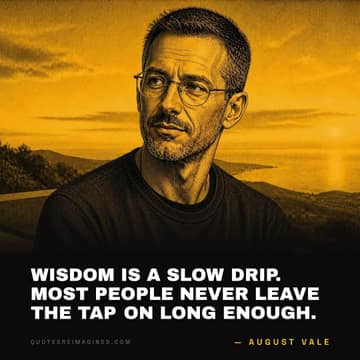
Wisdom is a slow drip. Most people never leave the tap on long enough.
Most people stop learning at graduation. That’s why they’re so easy to pass.
Resentment makes you boring. Every conversation turns into the same one.
Self-pity is a warm bath. Stay in long enough and it turns cold.
Second-hand opinions come with someone else’s regrets attached.
The most underrated tool in any trade is a chair you refuse to leave.
Work for the person who will use it, not the person who will grade it.
Nobody is a little bit trustworthy, any more than a bridge is mostly there.
Everyone autopsies their failures. Almost nobody studies what’s already working.
Simple ideas only look small. Take one seriously and it fills a career.
Most of winning is waiting with your hands in your pockets until the odds show up.
Quoting the expert is memory. Checking the expert is thinking.
Be brilliant and unreliable and you’ll only be remembered for the second one.
Trust is the only advertising that works better the quieter it gets.
You can hire knowledge by the hour. Judgment you have to grow at home.
Most people don’t fail. They stop early and call it being realistic.
Pick the game that fits your hands, then play it longer than anyone.
Winners make poor witnesses. They were too busy winning to see why.
Hard work doesn’t promise the win. It promises you deserved it.
You wait years for the one afternoon that counts. Stay sharp enough to notice it.
A heron standing in the shallows isn’t idle. Stillness is how it hunts.
Trusting someone isn’t believing they’ll never fail. It’s believing they’ll tell you first.
Reward what’s easy to fake and the office fills up with actors.
When people trust you, they stop reading the fine print. Don’t write any.
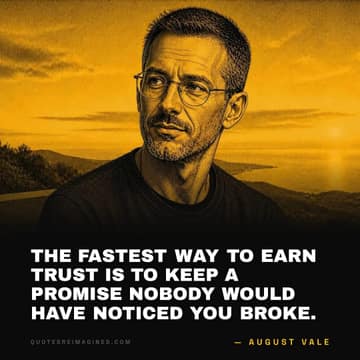
The fastest way to earn trust is to keep a promise nobody would have noticed you broke.
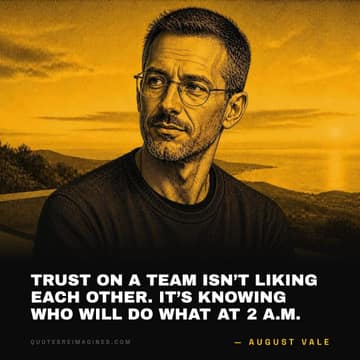
Trust on a team isn’t liking each other. It’s knowing who will do what at 2 a.m.
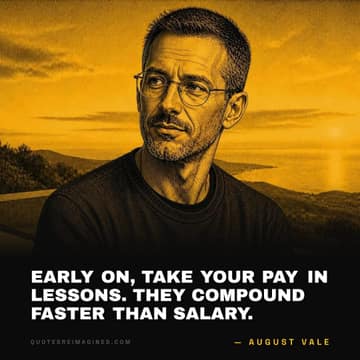
Early on, take your pay in lessons. They compound faster than salary.
Be an optimist about the decade and a pessimist about the quarter.
Whatever you pay for, you get more of, including the parts you didn’t mean to buy.
Greed never improvises. Find the incentive and you know the ending.
Most fortunes are lost by people who stopped being careful once it worked.
Insurance is the one purchase you hope turns out to be a waste.
Every expensive lesson came with a cheap warning you skipped.
Three words, I don’t know, have saved more fortunes than any spreadsheet.
A business can run short of cash for a month. It can’t run short of trust for a day.
Sell only what you’d be glad to buy, and you’ll never need a pitch.
The boring idea held for years beats the brilliant one held for weeks.
If you don’t understand it, you don’t own it. You’re holding it for someone who does.
In Munger’s own words
Resentment has always worked for me exactly as it worked for Carson. I cannot recommend it highly enough to you if you desire misery.
First, be unreliable. Do not faithfully do what you have engaged to do. If you will only master this one habit, you will more than counterbalance the combined effect of all your virtues, howsoever great.
Well, luckily I had the idea at a very early age that the safest way to try to get what you want is to try to deserve what you want.
I constantly see people rise in life who are not the smartest, sometimes not even the most diligent. But they are learning machines. They go to bed every night a little wiser than they were that morning.
I feel that I’m not entitled to have an opinion unless I can state the arguments against my position better than the people who are in opposition.
Learn how to ignore the examples from others when they are wrong, because few skills are more worth having.
Other sources1 quote
Harvard School Commencement Speech, Los Angeles4 quotes
Johnson spoke well when he said that life is hard enough to swallow without squeezing in the bitter rind of resentment.
My second prescription for misery is to learn everything you possibly can from your own experience, minimizing what you learn vicariously from the good and bad experiences of others, living and dead.
My third prescription to you for misery is to go down and stay down when you get your first, second, or third severe reverse in the battle of life. Because there is so much adversity out there, even for the lucky and wise, this will guarantee that, in due course, you will be permanently mired in misery.
It is in the nature of things, as Jacobi knew, that many hard problems are best solved only when they are addressed backward.
Harvard School Commencement Speech, Los Angeles (2006 postscript)1 quote
As I review in 2006 this talk made in 1986, I would not revise a single idea. If anything, I now believe even more strongly that 1) reliability is essential for progress in life, and 2) while quantum mechanics is unlearnable for a vast majority, reliability can be learned to great advantage by almost anyone.
USC Gould School of Law Commencement Address15 quotes
You want to deliver to the world what you would buy if you were on the other end.
And there is huge pleasure in life to be obtained from getting deserved trust.
You are not going to get very far in life based on what you already know. You’re going to advance in life by what you learn after you leave here.
Just as civilization can progress only when it invents the method of invention, you can progress only when you learn the method of learning.
If you turn problems around into reverse, you often think better.
If you’re unreliable, it doesn’t matter what your virtues are, you’re going to crater immediately.
So you want to be very careful with intense ideology. It presents a big danger for the only mind you’re ever going to have.
If you want to end up wise, heavy ideology is very likely to prevent that outcome.
Self-pity is always counterproductive. It’s the wrong way to think. And when you avoid it you get a great advantage over everybody else, or almost everybody else, because self-pity is a standard response. And you can train yourself out of it.
Generally, your outcome in life will be more satisfactory if you work under people you correctly admire.
I could force myself to be fairly good in a lot of things, but I couldn’t excel in anything in which I didn’t have an intense interest.
Another thing you have to do is have a lot of assiduity. I like that word because to me it means “Sit down on your ass until you do it.”
It didn’t make me unhappy to anticipate trouble all the time and be ready to perform adequately if trouble came.
In your own life, what you want to maximize is a seamless web of deserved trust.
Another thing to cope with is that life is very likely to provide terrible blows, unfair blows. Some people recover and others don’t.
A Lesson on Elementary, Worldly Wisdom, USC Marshall School of Business4 quotes
If the facts don’t hang together on a latticework of theory, you don’t have them in a usable form.
So you have to figure out what your own aptitudes are. If you play games where other people have the aptitudes and you don’t, you’re going to lose.
And the wise ones bet heavily when the world offers them that opportunity. They bet big when they have the odds. And the rest of the time, they don’t. It’s just that simple.
And people who could never win a chess tournament or stand in center court in a respectable tennis tournament can rise quite high in life by slowly developing a circle of competence, which results partly from what they were born with and partly from what they slowly develop through work.
The Psychology of Human Misjudgment8 quotes
Never, ever, think about something else when you should be thinking about the power of incentives.
An idea or a fact is not worth more merely because it is easily available to you.
The rare life that is wisely lived has in it many good habits maintained and many bad habits avoided or cured.
Of all forms of useful pride, perhaps the most desirable is a justified pride in being trustworthy.
I favor a tougher prescription: “See it like it is and love anyway.”
At Berkshire, there is a common injunction: “Always tell us the bad news promptly. It is only the good news that can wait.”
Dread, and avoid as much you can, rewarding people for what can be easily faked.
Some of the most important miscalculations come from what is accidentally associated with one’s past success, or one’s liking and loving, or one’s disliking and hating, which includes a natural hatred for bad news.