Kofi Annan
Nobel Peace Prize · 1938–2018Kofi Annan was a Ghanaian diplomat who served as Secretary-General of the United Nations from 1997 to 2006. He and the United Nations shared the Nobel Peace Prize in 2001.






Kofi Annan
Nobel Peace Prize · 1938–2018 · Seventh Secretary-General of the United Nations
Kofi Annan was a Ghanaian diplomat who served as Secretary-General of the United Nations from 1997 to 2006. He and the United Nations shared the Nobel Peace Prize in 2001.
- Quotes
- 12
- Vale lines
- 26
Reimagined by August Vale
26 new lines Vale wrote after Kofi Annan and another thinker. Tap one to see both originals.
Empathy is a passport. Most people only stamp it for countries they already like.
Small habits flap their wings quietly. The weather arrives years later.
A routine you chose survives a bad week. One you were handed rarely does.
Hang a new habit on an old one. The familiar carries the stranger in.
Textbooks keep the generals. Kitchens keep the grandmothers.
Bond over a shared enemy and the friendship ends the week the enemy leaves.
Defend one person and everyone watching learns where you stand.
Friends from other worlds are how you find out which of your rules are only habits.
A good marriage makes a terrible movie. Nothing happens for fifty years.
Two families’ ways can share one kitchen. Nobody’s grandmother has to lose.
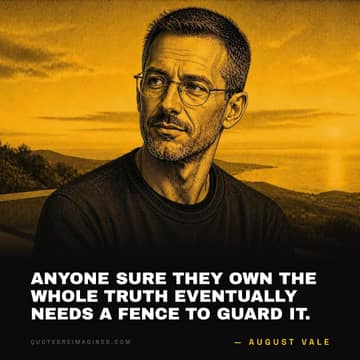
Anyone sure they own the whole truth eventually needs a fence to guard it.
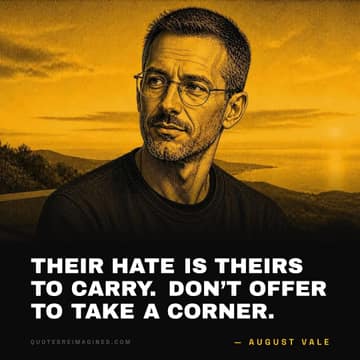
Their hate is theirs to carry. Don’t offer to take a corner.
Most new ideas are an old habit carried into the wrong room.
The best years rarely get a monument. They get a long lunch nobody photographed.
Poverty’s biggest cost never shows up on a bill. It shows up as talent that never got a turn.
Owing and owning are one letter apart and a whole life apart.
In Kofi Annan’s own words
Today’s real borders are not between nations, but between powerful and powerless, free and fettered, privileged and humiliated.
Nobel Lecture11 quotes
What begins with the failure to uphold the dignity of one life, all too often ends with a calamity for entire nations.
Peace must be sought, above all, because it is the condition for every member of the human family to live a life of dignity and security.
Only in a world that is rid of poverty can all men and women make the most of their abilities.
Most nations have monuments or memorials to war, bronze salutations to heroic battles, archways of triumph. But peace has no parade, no pantheon of victory.
The idea that there is one people in possession of the truth, one answer to the world’s ills, or one solution to humanity’s needs, has done untold harm throughout history – especially in the last century.
We recognize that we are the products of many cultures, traditions and memories; that mutual respect allows us to study and learn from other cultures; and that we gain strength by combining the foreign with the familiar.
Each of us has the right to take pride in our particular faith or heritage. But the notion that what is ours is necessarily in conflict with what is theirs is both false and dangerous.
We can love what we are, without hating what – and who – we are not. We can thrive in our own tradition, even as we learn from others, and come to respect their teachings.
People of all cultures value their freedom of choice, and feel the need to have a say in decisions affecting their lives.
The obstacles to democracy have little to do with culture or religion, and much more to do with the desire of those in power to maintain their position at any cost.
Today, we realize, perhaps more than ever, that the world of human activity also has its own “Butterfly Effect” – for better or for worse.